Dive Brief:
- Aurora Innovation expects to expand its driverless routes across the Southwestern U.S. this year, the company announced in an earnings release.
- The new route between Fort Worth, Texas, and Phoenix, Arizona, coincides with the company’s latest software release, its fourth since deploying driverless trucks in April 2025, per the Feb. 11 announcement. Dedicated and reefer coast-to-coast carrier Hirschbach Motor Lines is among the first customers to tap the new route.
- Co-founder and CEO Chris Urmson said improving technology and expanding in the Sun Belt enables the company to expand capacity for customers “to move goods at a scale that wasn’t possible before.”
Dive Insight:
Aurora Innovation’s latest advancement is another step in scaling the deployment of its technology. The company’s expansion brings its driverless route network total to 10, which it says triples its previous offering.
Aurora said it has now proved the capabilities of its driverless operations on a 1,000-mile lane between Fort Worth, Texas and Phoenix, Arizona. This positions the company as the first to autonomously haul freight on a route that extends beyond current service hours limitations, according to Aurora.
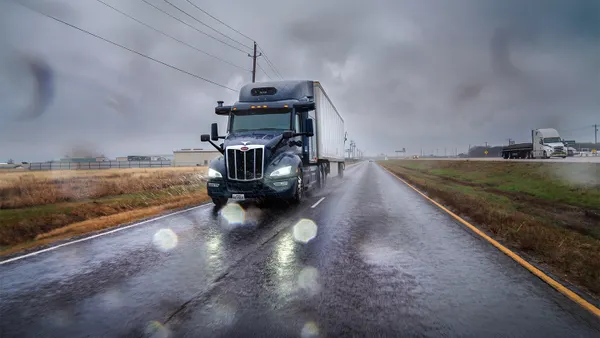
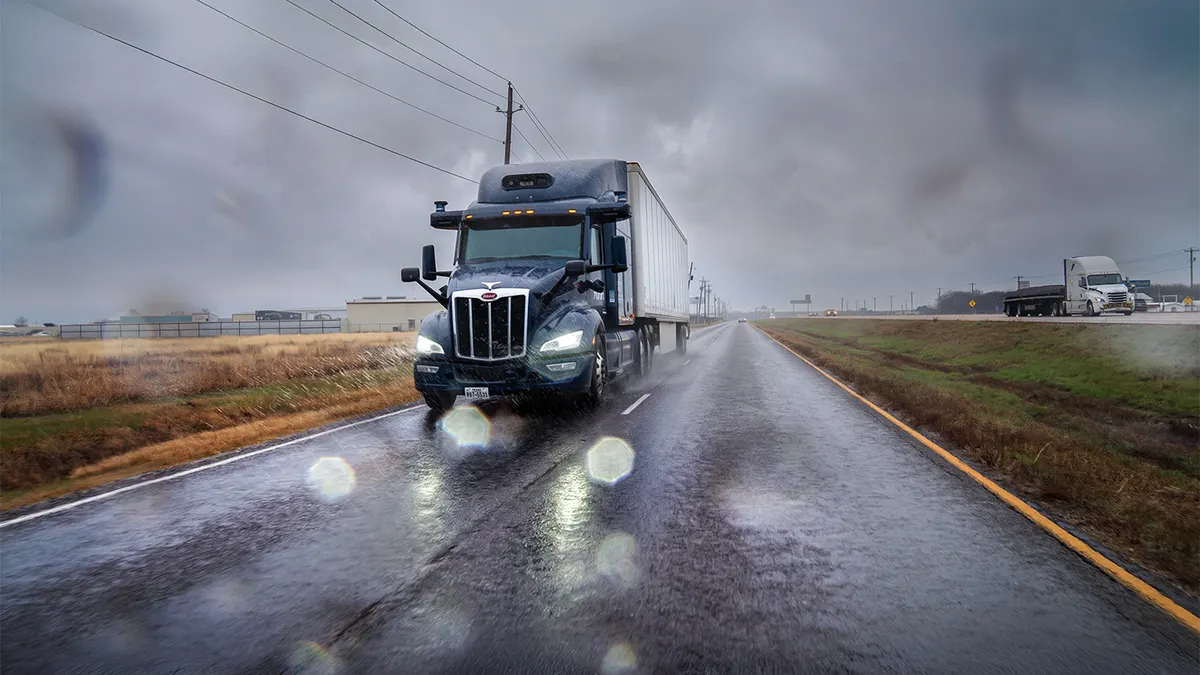
Driverless trucks equipped with Aurora’s technology can cut transit times in half and deliver efficiencies to carriers that single-driver fleets can’t, Aurora said. The company’s technology also operates on routes between Dallas and Houston, Fort Worth and El Paso, El Paso and Phoenix, and Dallas and Laredo.
The new development leverages AI to build maps for new routes at a much faster speed than before, with little or no human assistance. The company also started supervising autonomous freight delivery to support multiple customer sites, Urmson said during a call with analysts.
He said the company’s successful operations in the southwest “validates our core thesis that Aurora Driver can scale rapidly.”
During the analysts’ call, CFO David Maday added that the company expects to have 200 driverless trucks in operation by the end of the year, which translates to about $80 million in revenue from trucks it owns and operates.
“Building on the momentum of our landmark commercial launch, we are now focused on the execution and strategic investments necessary to scale,” Maday said.