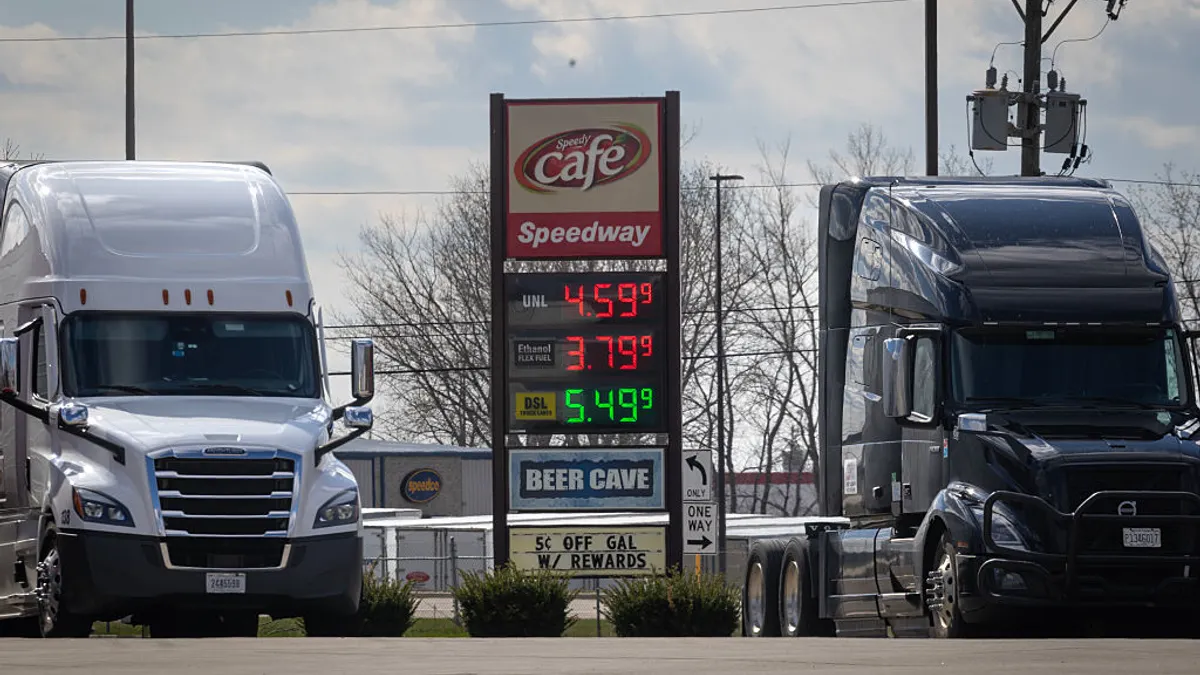
Brent crude oil prices dropped after the U.S. and Iran announced a two-week ceasefire, but immediate relief for diesel costs could take considerable time depending on how peace talks and the war unfold.
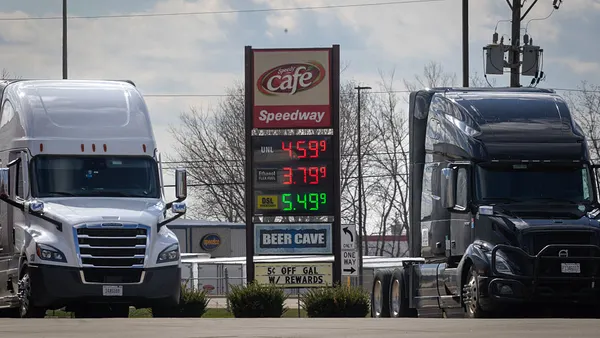
Prices had hovered around $110 per barrel early this week before dropping below $95 at times on Wednesday. Those costs in recent weeks have translated to rapidly rising diesel prices amid the Iran war, which reached a national average of $5.64 per gallon this week before the ceasefire pledges.
War between the countries severely restricted ship traffic through the Strait of Hormuz for weeks, sparking global concerns over oil supplies, which affect diesel prices. With the Tuesday deal, Iran’s foreign minister pledged safe passage for ships through the key waterway.
“I don't expect diesel prices to drop precipitously,” said Patrick Penfield, professor of supply chain practice at Syracuse University. Some drops might happen in a week or two, but until the conflict is resolved, which could be months, the U.S. won’t see a big drop in diesel prices, Penfield said.
During energy squeezes, there’s a tendency for prices to rise quickly and fall slowly, analysts note. But even after a crisis, higher baselines in pricing could also be set.
As of Monday:
- On-highway diesel prices increased by 24 cents week over week to $5.64 per gallon, according to the Energy Information Administration.
- The six-state Gulf Coast region from New Mexico to Alabama also rose faster than the national average with a 31-cent hike.
- Average diesel prices in California rose the fastest, by 34.8 cents to $7.57 per gallon, amid more long-term shifts away from in-state refinery production and greater reliance on foreign imports.
Fuel costs in West Coast states like Washington are “more volatile due to state taxes and fees that add even more to the price of gas and diesel,” Sheri Call, president and CEO of the Washington Trucking Associations, said in a Friday statement.
“It's all about supply and demand,” Penfield said, noting the global marketplace means domestic oil can command higher prices in global markets given the constraints.
That disruption, which can disproportionately affect smaller carriers, is pressuring truckers, shippers and consumers, TD Cowen’s equity research division said in a March 31 report. “The velocity of change in diesel prices is so significant that even carriers who have a fuel surcharge that re-prices weekly, will see a near-term squeeze” the report said, noting how pump prices can outpace fuel surcharges passed onto shippers.
Unlike previous energy crises, supply concerns are not the focus in the U.S. at the current time, according to Jeff Lenard, VP of media and strategic communications for the convenience association NACS. The U.S. produces more oil and gas than any country in the world. As of 2023, the U.S. produced 21.92 million barrels of oil per day, with field production of oil growing in recent years and setting a record in 2025.
“However, the longer that there is an imbalance between supply and demand related to the Strait of Hormuz, the greater the concern becomes about supply disruptions that could spread from Asia, Australia and Europe to North America,” he said in an email.
Following the U.S. and Israel attack in February, Iran’s strikes against commercial oil tankers and neighboring countries have caused U.S. gas prices to rise at home, President Donald Trump said in an April 1 address.
Despite the domestic gas and diesel price spikes, the nation’s dependence on oil shipped through the Strait of Hormuz has waned in recent years. As of the first half of 2025, 0.4 million barrels of crude oil and condensate traveled through the Strait of Hormuz per day to America, according to Energy Information Administration data analyzed by Vortexa.
Countries' reliance on Strait of Hormuz exports vary significantly
The U.S. previously estimated that crude oil and condensate exports from Persian Gulf countries traveling through the key global passageway represented about 7% of U.S. crude oil and condensate imports and 2% of U.S. petroleum liquids consumption in H1 2025. Exports in the strait went almost entirely to Asian markets.
The United Nations Trade and Development body has warned the war could slow global growth this year, particularly in developing countries. Improved manufacturing sentiment has been interrupted by the conflict, and weak trucking profits could persist but perhaps improve in late 2026.
Penfield advised businesses to examine where they could make quick logistical moves, given how rapidly the situation could change.