Dive Brief:
- Daimler Truck maintained its market share in North America in 2025 — a dominant 39.6% — despite a 16% year-over-year decline in Class 8 sales, executives said during the company’s Q4 earnings call on March 12.
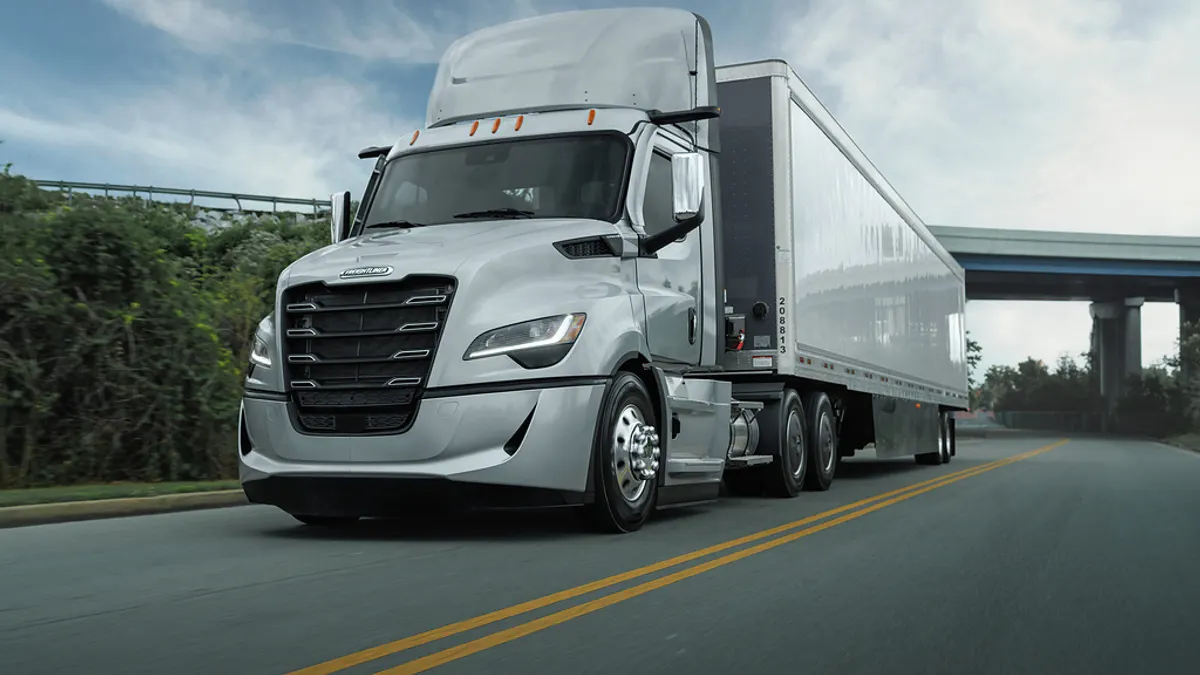
- The manufacturer of the Freightliner Cascadia sold 258,000 heavy-duty units last year, down from 308,000 units in 2024, as the industry continued to grapple with a prolonged freight recession and broader economic uncertainty.
- For 2026, the company expects the Class 8 market in North America to range from 250,000 and 290,000 units, according to its Q4 results.
Dive Insight:
Daimler Truck North America is taking a cautious stance on its 2026 outlook after last year’s freight downturn proved more persistent than expected.
During the earnings call, CFO Eva Scherer said the company deliberately set a conservative 6% to 8% return on sales estimate, even as Q1 order activity appears to be encouraging.
“That was a conscious decision that we took because we also saw how the market developed a bit different last year than we thought it would. And we could really see that this freight recession took much longer than we initially anticipated,” Scherer said.
The company wants clearer evidence that the recent momentum with orders represents a sustainable recovery before raising expectations, she added.
Trade policy is also weighing on profitability. Daimler Truck recorded a 250 million euro tariff-related loss ($286.59 million) in 2025. Without those costs, the company’s return on sales would have been around 12% instead of 10.7%, Scherer said.
To offset the impact, the manufacturer implemented a series of cost-control measures, including workforce reductions affecting about 3,000 employees and pricing adjustments tied to new model-year updates.
“We saw in quarter four when the Section 232 truck tariffs were introduced that we could not add additional tariff surcharges because we believe that our customers and the market couldn't digest it at that time,” Scherer said.
Daimler Truck executives now expect modest, single-digit pricing increases in 2026.