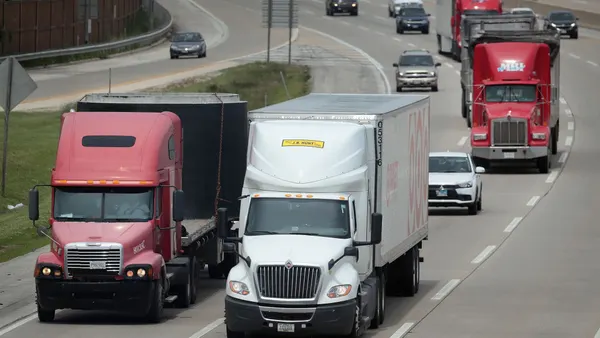
Some early signs of meaningful recovery for the freight market have been emerging, potentially signaling a noticeable shift from a painfully persistent downturn.
"Anything could happen this year," DAT iQ Principal Analyst Dean Croke said. "My money's on it being a crazy year."
Incremental and inflationary upticks in freight demand are projected for 2026 in the trucking industry, analysts and trucking executives suggested.
In 2025, capacity tightened, which may be what’s needed to drive a significant shift in the market. Consumer spending showed reservations but also glimmers of upticks — albeit unevenly. Tonnage has been sputtering along, but spot rates have appeared sticky following year-end spikes.
Forecasts suggest incremental and inflationary scenarios
For some industry voices, structural changes appear to be taking root. For others, the market may be similar to 2025's lackluster demand.
“We really expect for the overall truck freight market that 2026 will essentially be a repeat of the demand that occurred in 2025,” FTR Transportation Intelligence VP of Trucking Avery Vise said, noting that tariffs last year prompted some strong growth with earlier-than-usual demand, creating ups and downs amid a fairly sluggish market.
That base forecast for FTR calls for rates to rise in the range of inflation or possibly weaker than inflation, he said.
"Our best explanation here is that the market has tightened because of supply, not because of demand."
Mazen Danaf
Uber Freight principal economist and data science manager
Uber Freight is similarly forecasting multiple scenarios: a baseline where there’s incremental growth each month year over year, or an inflationary one, Principal Economist and Data Science Manager Mazen Danaf said.
“If the FMCSA regulation on non-domiciled carriers passes, the market could experience significant tightening leading to double-digit growth in spot rates,” Uber Freight said in December for its 2026 outlook.
In the baseline scenarios, spot rates should increase every month in 2026 compared to 2025, Danaf said.
The scenarios follow apparent structural changes in the market, Danaf said. Among them, he noted:
- In particular, spot rates increases from November to December are flashing red compared to usual seasonal uptick. An uptick in the mid-single digits month to month was shattered this year with a 15% increase.
- Year-over-year monthly metrics also suggest a structural shift may be occurring.
- A barrage of factors have also pointed to changing circumstances, such as a decline in long-distance truckload employment, weak tractor sales, and pressure on Federal Motor Carrier Safety Administration revocations.
“Our best explanation here is that the market has tightened because of supply, not because of demand,” Danaf said. He and other analysts have stressed that federal regulations have not had a sizable effect at this point. For Danaf, those trends were building even prior to federal policy changes such as English language proficiency penalties and more stringent non-domiciled documentation requirements that emerged last year.
If demand remains lackluster, the only way out may be through supply constraints, but that’s rare, analysts say.
“I would imagine that there will be small, incremental increases from last year overall,” Owner-Operator Independent Drivers Association Foundation Executive Director Andrew King said. “But will it be enough to kick us actually into an upcycle?”
Analysts note a market turn is still on hold
For King, a key aspect in moving into a new market cycle is a dispersion of freight, where needs are pushed into lots of different sectors at the same time, pushing capacity to its max and triggering significant shifts in rates.
“That has been true going back to the last several market cycles,” he said. For example, the beginning of 2017 saw a series of pressure cooker factors converge: the electronic logging device rule implemented along with fracking and housing booms. “The opposite is also true,” he added, noting that when there’s less dispersion, rates fall.
Another leading indicator recently provided a hopeful sign of market improvement, suggesting potential tightening in demand and carriers’ favor. Tender rejections, where a contracted carrier declines a shipment, saw a significant, persistent rise at the end of 2025, but it may have just been temporary, according to Ryder’s January “State of the Industry Report” using SONAR data.
Estes Express Lines President and COO Webb Estes noted factors to watch for him are retail spending, contrasts in weather impacts this winter compared to the previous one, declining interest rates and housing activity.
"It seems right now that things are stabilizing, and that puts you in a position to potentially start to see growth."
Webb Estes
President and COO
He expressed optimism for 2026 and said that last year tariffs made many people nervous. But the industry weathered those changes, and compounding effects of tariffs don’t appear to be coming this year, he said.
"It seems right now that things are stabilizing,” he said, “and that puts you in a position to potentially start to see growth."
Nevertheless, the historic growth of the industry during the COVID-19 pandemic and subsequent capsizing fueled a three-year freight recession. During President Donald Trump’s second term, policies involving tariffs and tougher standards on driver eligibility may be throwing traditional signals on the state of the industry out of whack.
DAT’s Croke said the industry is adapting.
“We've learned to become accustomed to anything is possible in this freight market in the last year,” he said. “Our old ways of looking at the freight market are kind of out the window.”
Supply Chain Dive Editor Kelly Stroh contributed to this report.