Freight brokers and motor carriers could see a very different environment depending on how the Supreme Court resolves a case that has potentially far-reaching effects for their industries.
The case, Montgomery v. Caribe Transport II et al., involves a tractor-trailer driver colliding with a parked Mack tractor-trailer that had stopped on the side of a highway in Illinois in December 2017. A central issue of the case is whether the broker, C.H. Robinson Worldwide, has legal exposure or not.
The crash happened when the commercial vehicle rammed into the legally parked truck at full speed, according to the brief for plaintiff Shawn Montgomery. Montgomery was severely injured in the crash, leading to the amputation of a leg. He also sued the driver, carrier, C.H. Robinson and affiliated companies, and his medical needs persist, according to court documents.
When trucking crashes involve a freight broker, injured parties sometimes sue the broker under state tort law on the basis that the broker acted negligently in selecting a motor carrier, claiming the broker knew or should have known about the carrier’s inadequate safety practices, legislative attorney Bryan Adkins noted in a Congressional Research Service report.
But the case could have legal effects for businesses across the country: Notably, it could bring clarity about the extent to which particular liability under state tort is applicable or not. That's part of a longstanding principle known as federal preemption concerning U.S. law that brokerage advocates say protects them from motor carrier safety lapses.
"The core issue is whether federal law from the '90s was meant to protect brokers from state negligent hiring claims when they select carriers," Ryan Wilson, VP of Broker Engagement at Matterhorn Insurance Group, said in an email. "Some courts have said yes, others have said no, which is why the Supreme Court stepped in."
The Federal Aviation Administration Authorization Act and a 1995 expansion were meant to create a national framework so brokers and carriers weren't subject to a patchwork of different state regulations tied to their services, according to brokerage and affiliated advocates. A safety exception within federal law for states adds a layer of complexity to the matter.
“[F]or nearly a century, federal law has comprehensively regulated interstate trucking, and Congress has expressly preempted states from using their tort laws to impose new duties on freight brokers and shippers,” C.H. Robinson also said in a news release about the case.
The outcome is instrumental for industry stakeholders because the court could:
- Shield brokers from claims like negligent hiring
- Find that brokers are susceptible to state tort, where liability can vary by location
- Have another resolution that remains to be seen
"The most likely outcomes are a ruling affirming preemption (the position the U.S. government supports), or a narrow textual ruling that resolves the circuit split without wading into every downstream issue," Husch Blackwell transportation attorneys said in an email.
If the Supreme Court finds in Montgomery’s favor, then that could reverse multiple lower-court decisions.
Potentially far-reaching effects for brokerages and small carriers
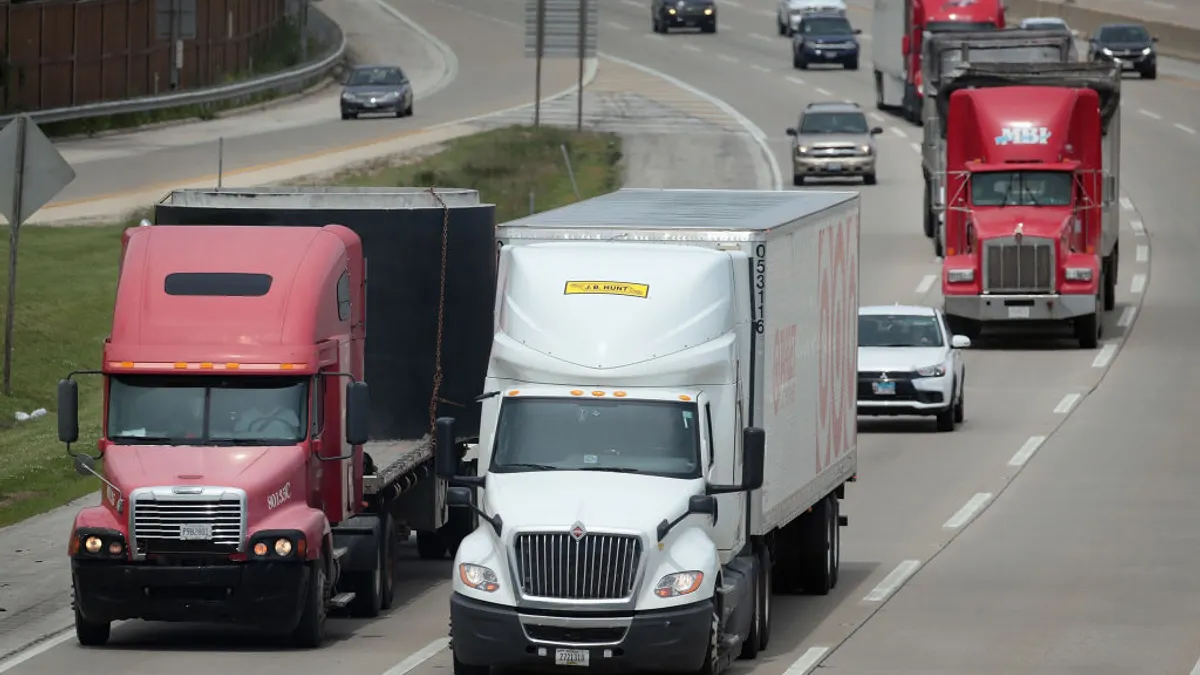
Brokers; transportation companies with brokerages, such as ArcBest, J.B. Hunt Transport Services and Saia; and manufacturers have warned the Supreme Court about what's at stake.
Those advocates have suggested a ruling favoring the plaintiff could create supply chain inefficiencies as well as higher costs and even destroy "hundreds of thousands of small trucking companies," according to briefs.
Those concerns stem in part from how brokers, depending on the outcome of the case, might shift the types of carriers selected. That could mean smaller carriers become overlooked in favor of larger carriers, “regardless of their individual safety records,” one brief to the court said.
Fewer motor carriers will mean higher rates for remaining carriers with costs passed on to manufacturers, retailers and consumers, C.H. Robinson said in its brief.
"If brokers can't rely on federal standards, the resulting liability patchwork could have real life downstream effects," said Harry Byrne, a partner with Duane Morris.
Insurance premiums could rise for brokers, and some brokers could even be priced out of the market, he said.
"I think those are all real significant implications of a potential ruling, and again, a reason why you should have a single, uniform standard, as opposed to the state by state standard where, in effect, the most stringent state would set the standard for everybody else,” Byrne said.
During the March 4 oral arguments of the case, Justice Brett Kavanaugh expressed concerns for such ripple effects in the marketplace. His questions suggested he was trying to assess the day-to-day impact of the current state of the law and the potential change of the law on how the logistics industry will function, said Armstrong Teasdale Partner Matt Reh, who was primarily involved in handling the case for C.H. Robinson at the district and appellate levels.
A case finding for the plaintiff could mean property freight brokers become more likely to use medium-sized carriers or larger carriers, based on assessments about those entities’ ability to certify regulatory requirements, Reh said. That could mean brokers have to rethink how they manage their involvement with motor carriers and which motors to select.
"To me, the question is how far does the Supreme Court go with this? Is it going to say that there is no preemption? Is it going to say that preemption is limited to negligent hiring and retention claims, or is it going to say that all claims that arise out of alleged negligence are preempted?" Reh said.
Regardless of outcome, additional change could come
Congress is monitoring the case, and the outcome could spur the losing side to find legislative relief.
But independent of the case, brokers should also take note that the more control they have over a carrier, the more potential legal exposure they have, attorneys say.
That's because in those circumstances, brokers move away from the role of intermediaries and become "more like de facto employers, which invites liability exposure beyond negligent selection," Husch Blackwell attorneys said.
Reh said this involves a body of law that exists in each state, and it’s referred to in different ways.
“Some people refer to it as agency,” he said. “Some people refer to it as vicarious liability. Some people refer to it by a Latin phrase called respondeat superior.”
The principle can put the burden on those who have responsibility for acts or omissions of a person being controlled, Reh said. That might entail giving instructions to drivers, contract provisions requiring check-ins or requiring a carrier to have a broker's logo on the trailer, attorneys said.
Currently, brokers also already spend a lot of time vetting carriers before they ever assign a load, Wilson noted.
"Most will verify things like a carrier’s FMCSA authority, insurance coverage, safety scores, inspection history, and operating status to make sure the company is legally authorized and compliant,” he said. Many brokers also use third-party vetting tools and internal policies to monitor carriers over time. A lot of capital is being spent on these tools."
But that's mostly confined to public information, as opposed to operational data that regulators or the motor carrier itself has, such as driver records, internal safety practices or day-to-day vehicle maintenance, Wilson said.
Contracts that require further disclosures from carriers or transformative laws could change those dynamics. But as of now, brokers can already have considerable expenses in vetting carriers, and they can't access the Federal Motor Carrier Safety Administration's Drug and Alcohol Clearinghouse, he said.
"That’s part of why this issue is complicated," Wilson said. "Brokers are being asked to evaluate carriers without access to some of the deeper safety data that regulators or the carrier itself can see.”