Dive Brief:
- Daimler Truck North America is planning to build a new manufacturing facility in the U.S., with production expected to begin in late 2029, the company announced last week.
- “This investment gives us the rare opportunity to start with a blank sheet of paper and create a state-of-the-art facility, which will be designed around the latest manufacturing technologies, a flexible production system, and of course, the products that will define our future. Startup production is planned for late 2029,” CEO Karin Rådström said during the company's Q2 earnings call held Aug. 7.
- The announcement comes days after Daimler confirmed it will close its Portland, Oregon, plant Oct. 30, shifting production to facilities in North Carolina and South Carolina. Portland will remain the company’s headquarters and engineering hub.
Dive Insight:
Daimler Truck North America is considering “multiple potential locations” based on factors including supply chain access, skilled workforce availability, transportation and logistics infrastructure and the business environment.
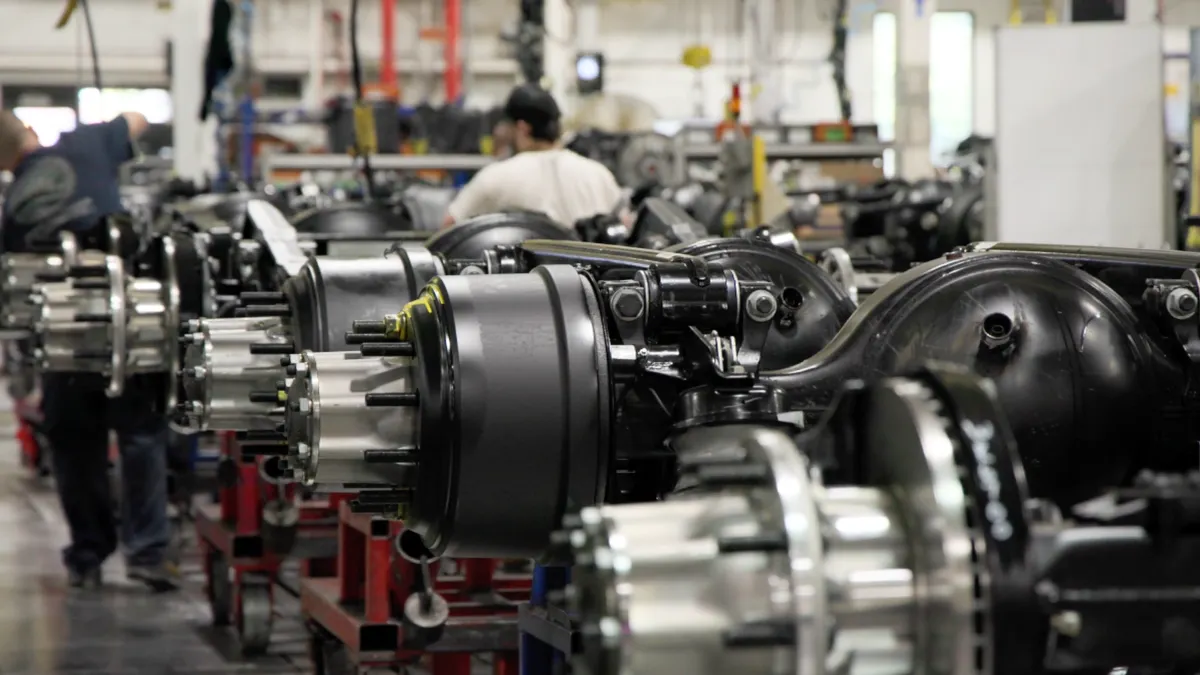
The facility should be more efficient than Daimler’s existing plant because a new greenfield site allows the company to capture efficiency gains that are difficult to achieve through incremental improvements as brownfield facilities, CFO Eva Scherer said.
“We will use state-of-the-art technologies, and we will of course also use very high automation rate, and use really everything that is available when it comes to automation and digitalization of this facility,” she said during the earnings call.
The additional capacity will give Daimler Truck more flexibility to distribute volumes across its networks, Rådström added.
That flexibility could become increasingly important as demand strengthens. Daimler Truck North America’s order intake topped 35,000 units in Q2, a 156% year-over-year jump, while unit sales rose 8%.
The stronger demand outlook prompted Daimler Truck to raise its North American guidance. The company now expects to sell 160,000 to 180,000 trucks in 2026, up by roughly 10,000 units at both the low and high end of its previous range. It also raised its return-on-sales outlook to 9% to 11% from 6% to 8%.