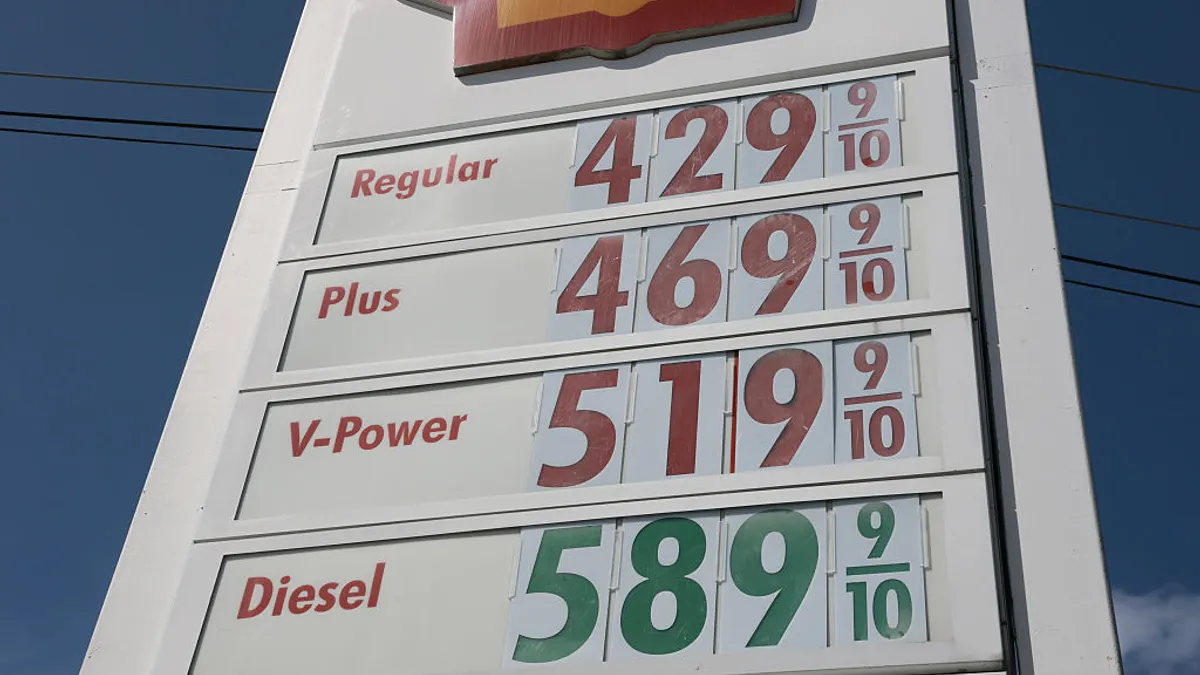
On-highway diesel prices dropped by 3.5 cents to $5.608 per gallon Monday, but fuel prices could remain sticky with diesel costs staying high for months, experts said.
Energy Information Administration data released this week showed a mix across different regions. Most regions, including California, saw relief, but prices rose week over week in New England, Central Atlantic and Midwest regions.
"While the term 'new normal' may conjure unpleasant memories of the COVID era, businesses should brace themselves for a new normal of elevated fuel costs," Andy Dyer, CEO of AFS Logistics, said in a news release.
He noted that pricing changes, particularly in parcel, tend to be “‘sticky’ with effects that linger even after the underlying price of fuel recedes.”
Recently, the Iran war’s 14-day ceasefire agreement gave a glimpse of hope of bringing Strait of Hormuz ships, oil product exports and pricing back to normal. But tensions are persisting amid a breakdown in peace talks, the nonprofit Foundation for Defense of Democracies noted, and President Donald Trump ordered a Strait of Hormuz blockade for ships going to and from Iran's ports.
Brent crude oil has been trading at below $100 a barrel, but supply systems and more near-term pricing is showing continued disruption.
“Until we see the return of traffic to Hormuz, there is no reason to think the global supply crunch for crude oil and refined products will ease, regardless of whether a ceasefire is in place,” Michigan State University Supply Chain Management Professor Jason Miller told Trucking Dive Thursday in a LinkedIn message.
He noted the importance of monitoring the Dated Brent contract compared to the crude oil price. The former reflects more immediate pricing environments in the next 10-30 days, whereas the latter is currently for June.
“[T]he fact crude oil futures for May (WTI) and June (Brent) delivery are below $100 a barrel doesn't provide an accurate gauge of how tight global crude oil supplies are,” Miller said in a LinkedIn post. “Every day that tanker traffic through Hormuz remains well below Feb. 27 levels will make this worse.”
Additionally, the war has damaged petrochemical plants and refineries that extend beyond Iran. Middle East Economics Professor of Practice Nader Habibi of Brandeis University noted that those production facilities “will be affected for at least a few months until repairs are complete.”
In LTL for Q1, a sharp rise in fuel surcharges drove a 3% quarter-over-quarter increase in cost per shipment, according to the TD Cowen/AFS Freight Index.
“Mixed signals and uncertainty continue to characterize the macroeconomic picture, with the U.S. economy decelerating to 0.5% growth in Q4 2025 and renewed inflation concerns as escalating conflict in the Middle East caused oil prices to soar 50% in March, pushing inflation to 3.3%,” the news release for the index said.
Tighter capacity is helping push the TL rate per mile index to reach a projected 10.1% increase above the January 2018 baseline, the first time for a quarter reaching above 10% in over three years, the businesses said.
But rising rate forecasts are not primarily driven by diesel prices but instead rising operating costs and capacity constraints, which have been pressured in markets such as Arizona, California and Texas, a C.H. Robinson Worldwide report noted this month.