Dive Brief:
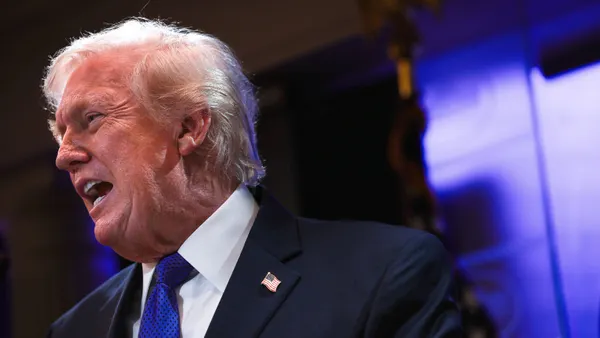
- The Environmental Protection Agency eliminated a 2009 scientific finding Thursday, Administrator Lee Zeldin said at a news conference alongside President Donald Trump, describing the move as the largest deregulatory move in U.S. history.
- The endangerment finding had been cited to justify a series of emissions regulations, including Phase 1, Phase 2 and Phase 3 greenhouse gas restrictions for heavy-duty OEMs.
- “For years, unelected bureaucrats twisted the Clean Air Act into something it was never meant to be,” Zeldin said. “If Congress wants EPA to regulate the heck out of greenhouse gases emitted out of motor vehicles, then Congress can clearly make that the law.”
Dive Insight:
Because of the absence of the scientific finding, the agency is also rescinding Phase 1, Phase 2 and Phase 3 greenhouse gas emissions rulemakings for heavy-duty vehicles, the EPA said.
At the same time, the agency also said the endangerment finding rescinds those emissions standards for vehicle and engine manufacturers. But the nonpartisan Congressional Research Service said that policy change “would not, by itself, repeal those later-issues regulations.”
The change in environmental policy under the Clean Air Act would also be subject to judicial review, the Congressional Research Service noted.
The rule is effective 60 days after it’s published in the Federal Register.
Zeldin referred to previous administrations as producing regulations not grounded in reality while at the same time defending the EPA’s mission.
“This EPA is committed to providing clean air for all Americans,” he said. “EPA will never waver on its core mission of protecting human health and the environment.”
The move drew praise and criticism from industry groups.
Owner-Operator Independent Drivers Association President Todd Spencer said that prior EPA gas rules threatened to regulate many small business truckers out of existence. “Electric commercial trucks remain prohibitively expensive and impractical for small carriers due to the upfront cost, reliability concerns, and lack of charging infrastructure,” he said in a statement.
The Clean Freight Coalition, which represents industry groups such as the American Trucking Associations, National Private Truck Council and Truckload Carriers Association, said the move gives the industry flexibility and certainty needed to innovate and invest in solutions that are environmentally responsible and economically viable.
Clean transportation nonprofit CALSTART’s CEO Michael Berube said while other countries are reducing emissions from vehicles while improving affordability, “the U.S. is taking a step backwards on its blueprint for transportation decarbonization.”
Another advocacy group, the Zero Emission Transportation Association, described the move as leaving companies left to navigate the market without a unified federal rule book. “Companies will now have to navigate a complicated patchwork of state regulations, threats of costly tort litigation, and inconsistent rules between markets,” ZETA Executive Director Albert Gore said in a statement.