
FedEx is ramping up the presence of robotic arms for trailer loading in a bid to boost productivity and limit strenuous employee tasks.
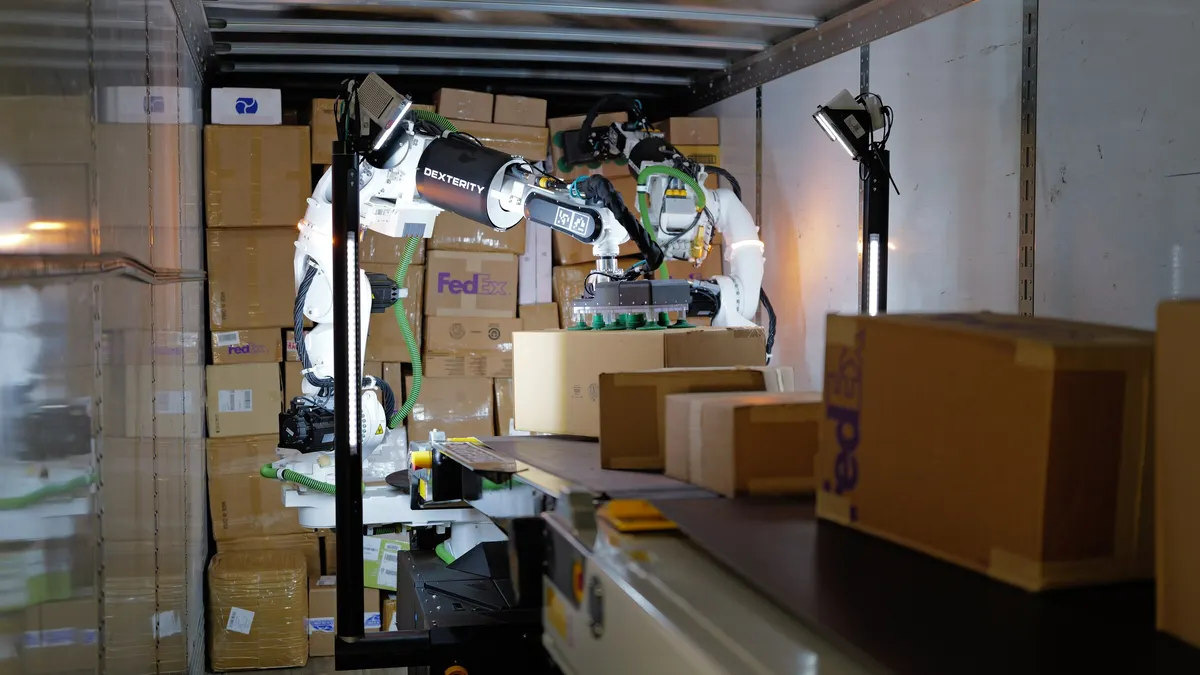
On July 30, FedEx announced in a news release the deployment of Dexterity's dual-armed Mech trailer loading systems at its Maryland-based Hagerstown Hub. The systems are powered by Foresight, Dexterity's model that makes real-time decisions to optimize package placement during the autonomous loading process.
Tens of thousands of trailers are loaded daily across FedEx's U.S. network. The release said trailer loading has been historically difficult to automate and is one of parcel logistics' "most physically demanding and challenging workflows," requiring strength, endurance and real-time problem solving among employees handling the task.
"Hagerstown represents an important milestone in demonstrating how physical AI can operate reliably in a high-volume logistics environment, creating a blueprint for network expansion," Dexterity founder and CEO Samir Menon said in the release.
FedEx has been testing automated trailer loading technology with Dexterity for years, with plans to scale further in the future. Over the next few years, the carrier aims to deploy automated trailer unloading and loading operations across thousands of dock doors in more than 20 U.S. hubs, EVP of planning, engineering and transformation Kawal Preet said during the company's 2026 Investor Day in February.
Other logistics heavyweights have tapped into robotic arms technology to help unload goods from trailers over the past few years. Last year, DHL announced a deal to deploy over 1,000 additional units of Boston Dynamics' Stretch robot. And in 2023, the U.S. Postal Service installed a parcel robotic sorting system in a Kansas distribution center featuring a mechanical arm to unload pallets, per an Aug. 3 report from the agency's Office of Inspector General.
Use cases for robots within warehouses are not limited to trailer unloading: Amazon has deployed more than 1 million robots across its network since 2012. The company plans double its fleet of robotic arms in 2026 as part of efforts to boost fulfilmment network efficiency, SVP and CFO Brian Olsavsky said on a July 30 earnings call.
Robotic arms the company uses include Cardinal, which lifts packages and places them in carts, and Sparrow, which moves products from containers to totes before packaging. Both technologies leverage AI and computer vision.
A significant expansion of Amazon's robotics fleet "is likely to influence not only its own operations, but also broader trends across the automation industry," said Aaron Prather, director of market intelligence at the Association for Advancing Automation (A3), in an email to Supply Chain Dive.
"Recently, non-automotive industries surpassed automotive as the largest purchasers of industrial robots," Prather said. "Companies such as Amazon and FedEx are helping fuel this shift through continued automation installs across their extensive logistics and fulfillment networks."