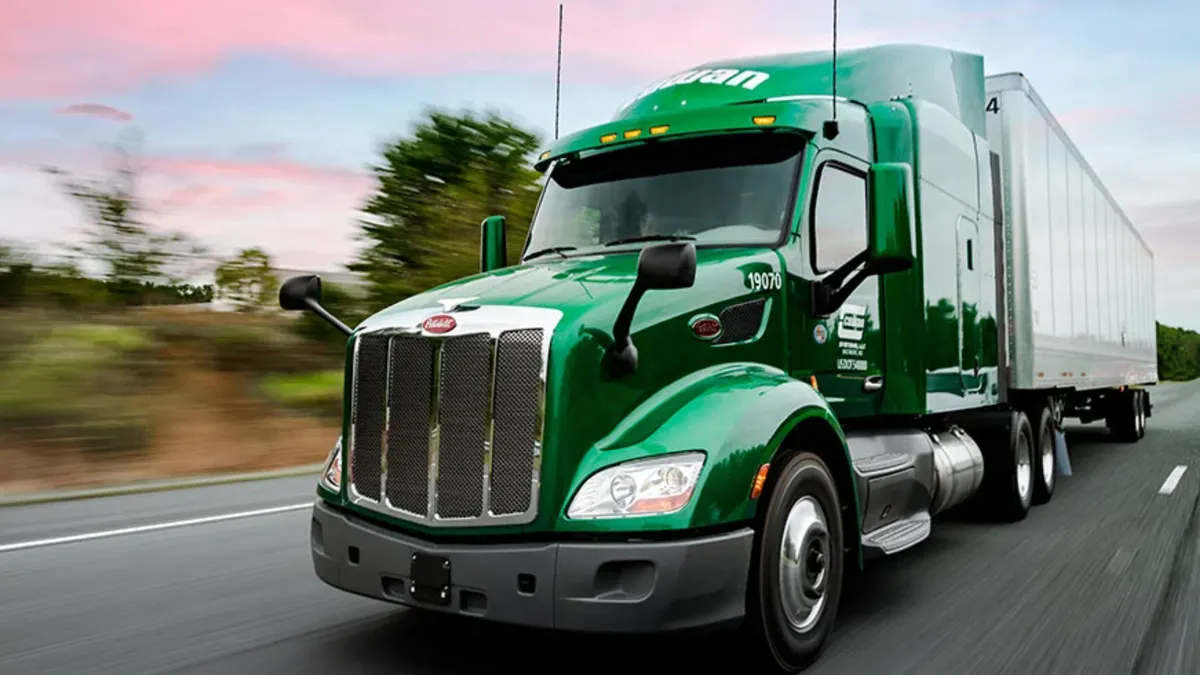
Once FedEx Freight spins off as its own company June 1, business may be different, experts say.
Following parent company FedEx's announcement of the plan in December 2024, the subsidiary has named executive leaders, including a CEO and CFO, and has hired hundreds of sales and support staff dedicated to growing the business. These steps and others have led up to Wednesday’s investor day for FedEx Freight, where experts hope to receive clarity on the direction for the new standalone business.
How will the company seek revenue growth?
A key issue is how FedEx Freight will grow revenue, following recent declines.
Several opportunities abound for its freight portfolio, Jason Miller, a professor of supply chain management at Michigan State University, said in an email to Trucking Dive. Potential fits could be electrical goods and components, computers and electronics as well as sectors benefiting from the artificial intelligence boom and health care, he said.
Amid tonnage and shipment declines compared to four years ago and a slim operating margin of 0.4% in its most recent quarter, there are questions about what customer segments the carrier might focus on for additional business, he said.
Jonathan Phares, assistant professor of supply chain management at Iowa State University, said in an email that additional specifics are needed about FedEx Freight’s revenue growth plans.
The company has noted that the spinoff enables more tailored strategies while preserving synergies, but it will be important for FedEx Freight to provide a concrete explanation of how that balance will work in practice, he said.
“It would also be useful to understand what percentage of FedEx Freight's current revenue flows through FedEx parent relationships," Phares said, "and is that at risk post-separation?”
What does an independent FedEx Freight look like?
Geoff Wilson, director and lead analyst for transportation at S&P Global Ratings, believes FedEx Freight’s extensive network that services 98% of U.S. zip codes creates opportunities to capture specialized markets such as trade shows or shippers seeking expedited point-to-point service.
However, like others in the industry, Wilson said in an interview with Trucking Dive that he hopes executives will discuss the company’s goals. Though he wonders what FedEx Freight will be able to do differently when operating independently that it couldn’t do previously.
“They make it sound like, okay, now that we’re on our own, we can do different things, or maybe just have more dedicated focus on the business,” Wilson said.
Whatever FedEx Freight executives disclose on Wednesday, Scooter Sayers, an LTL consultant with Sayers Logistics, said in an email that he recognizes a formidable carrier setting its own direction will be operating in the marketplace June 1.
“FedEx Freight will now be free to make their own decisions, with their own resources, rather than having some decisions dictated by their parent company, and competing for resources,” Sayers said. “We can expect FedEx Freight to operate differently when stand-alone.”