Dive Brief:
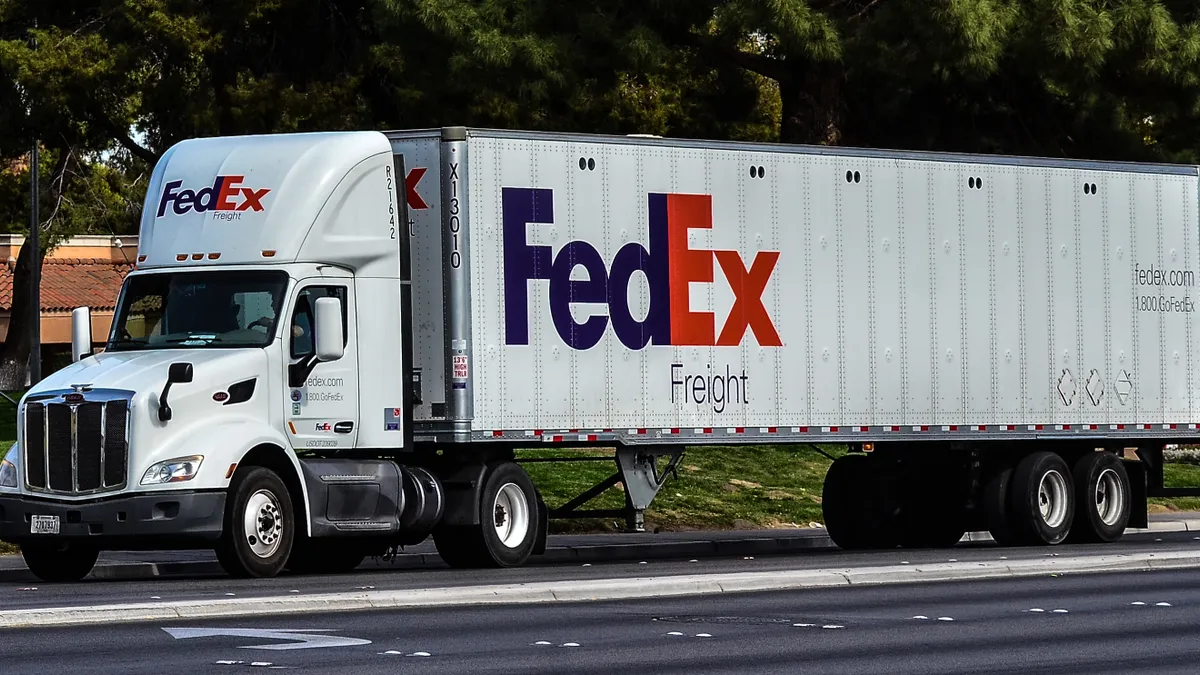
- FedEx’s Freight segment faced shipment and revenue declines during its last fiscal quarter amid LTL market demand challenges, the company reported Thursday.
- Average daily shipments declined by roughly 6% year over year, pressuring revenue for the quarterly period ending Feb. 28, according to a securities filing. Revenue declined 5% to nearly $2 billion YoY.
- Nevertheless, the segment achieved sequential increases in both revenue per shipment and contractual price increases as it prioritizes revenue quality amid LTL market challenges, EVP and Chief Customer Officer Brie Carere said on an earnings call.
Dive Insight:
FedEx Freight, which is set to become a standalone company June 1, cited setbacks in macroeconomic conditions for the YoY decreases in shipments and revenue. Such conditions included "continued weak industrial production, global trade policy uncertainty, and excess capacity in the LTL industry," according to the filing.
Other LTL carriers recently reported a mix of volume changes, even as manufacturing indices in January and February notched long-awaited improvements in the market. Amid that mix, FedEx Freight saw weight per shipment for economy service and revenue per hundredweight increase slightly to $41.08 YoY.
But costs related to its spinoff totaled $195 million, leading operating income to collapse to $8 million for the quarter, down from $261 million a year ago.
Nevertheless, FedEx Freight leadership said they feel well positioned to capture growth as the market recovers, highlighting the segment’s updated LTL sales force while pointing toward pricing discipline and contract renewals.
FedEx Freight incoming CEO John Smith said on the earnings call that the business plans to provide “an outstanding sales experience” that’s “data-driven with personalized service for our customers.”
An Investor Day for the segment is planned for April 8.