Dive Brief:
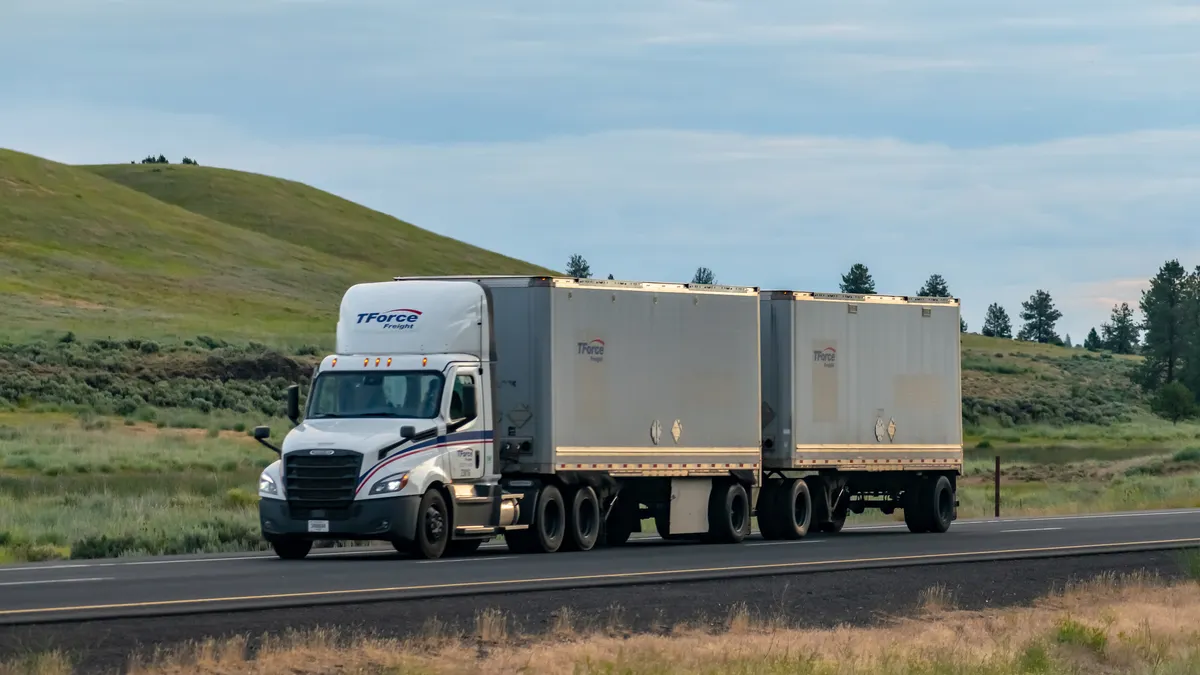
- TFI International truckload operating income nearly doubled to $100 million for Q3, while LTL Q3 fell to $44.4 million, down $33 million from Q3 2025, the transportation conglomerate reported in its Oct. 29 earnings announcement.
- Higher fuel costs in tandem with poor LTL density in the U.S. contributed to the LTL drop, CEO and President Alain Bédard said on an earnings call. He also cited the constraints with unionized operations, which TFI absorbed when acquiring the U.S. LTL business from UPS in 2021.
- “When you look at our Q3 numbers, we did fantastic everywhere except our U.S. LTL,” Bédard said on the call.
Dive Insight:
As UPS Freight, retail was part of the business, but successor TForce Freight has shifted that freight makeup entirely to industrial, Bédard said.
But with TL business booming, TForce Freight needs to piggyback off that, he said.
“This is something that's ongoing to try to improve, the weight per shipment, at the same time as the revenue per shipment,” he said.
In its LTL segment, average weight per shipment in Q3 was 1,480 pounds, a 3.6% decrease from a year ago, according to an earnings report. Revenue per hundredweight, excluding fuel, declined by 0.9% during those same time frames.
The carrier is also bringing in new talent from outside the UPS world to integrate into TForce Freight, Bédard said. “We're going to change the recipe,” he said, noting the issue is centered on management as opposed to drivers or dock workers.
TFI wants to remain in the U.S. LTL market, he added.
Amid those setbacks, U.S. LTL volume has been soft for years, and that’s expected to continue in 2027, Bédard said. But pricing is at least holding, and the U.S. LTL business should improve in 2027, he said.
LTL shipments have also stabilized this year after a challenging nine months, and the company acknowledges service levels must not falter.
U.S. LTL competitors saw a different picture across those metrics TFI highlighted.
For Old Dominion Freight Line from Q3 2025 to Q3 2026, average LTL weight per shipment increased by 1.9%, and LTL revenue per hundredweight, excluding fuel surcharges, rose 5.1%, according to an earnings announcement.
During those same time frames for Saia, average LTL weight per shipment rose 8.1% while LTL revenue per hundredweight, excluding fuel surcharges, dropped 2.2%, according to an earnings report.