Fleets in places such as Southern California are converting their existing diesel tractors to battery-electric setups with companies, allowing batteries to be swapped in minutes.
In contrast to alternatives such as the Tesla Semi, swappable batteries are designed to easily and quickly exchange a battery with a fully charged one. But the Semi has a 500 mile range and can recover about 60% of its range in 30 minutes with a Megacharger, the OEM says.
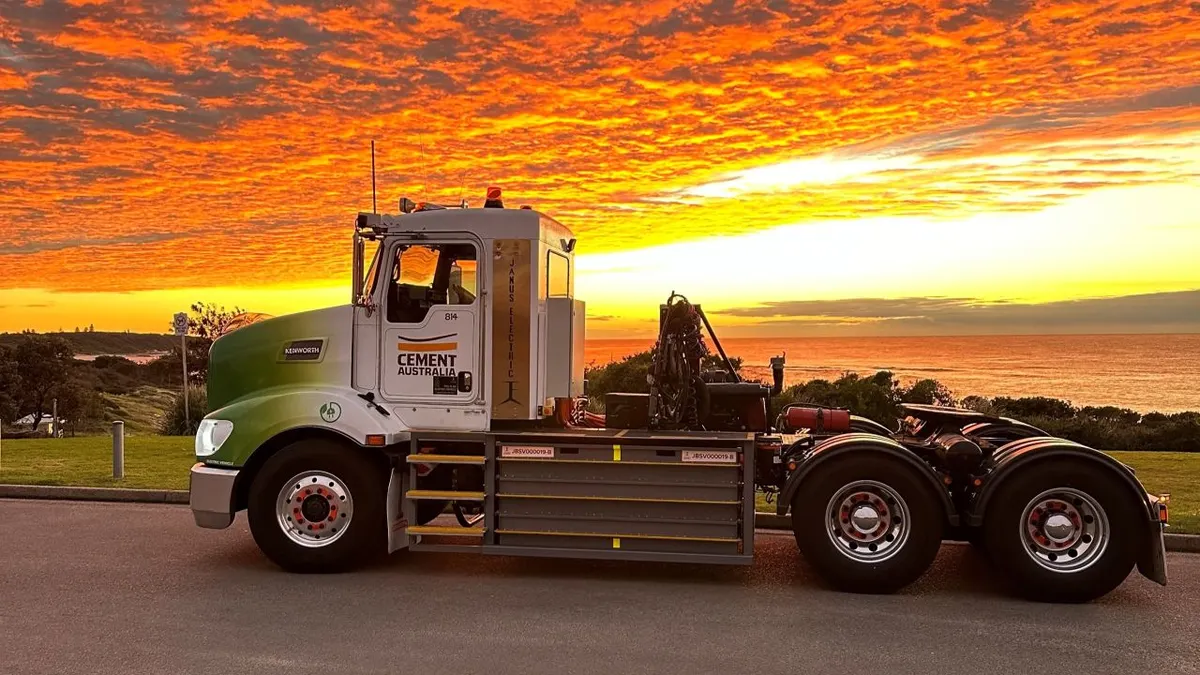
Ability Tri-Modal Transportation Services detailed how it’s adapted its fleet to Janus Electric technology, where batteries on trucks can now be swapped out within four minutes, “so there’s no dwell time,” EVP Mike Kelso said in a video. Added infrastructure allows charging within three hours, he added.
The conversion repurposes an existing diesel tractor with a new engine and switches out the fuel tanks for battery storage, Kelso said. Each conversion costs about $175,000, but the California-run Clean Truck and Bus Voucher Incentive Project, known as HVIP, reduces the price by $112,000, he said. That brings the total cost down to about $40,000 to $50,000.
"We're able to reuse the existing assets, the Class 8 tractors, by converting them to battery electric," Kelso said.
Janus Electric has been extending its reach in California and Texas markets with its U.S. and Canada order book reaching 118 as of late August.
Other heavy-duty electric tractors are also gaining ground. A coalition of shippers agreed to a 2,500-unit order of battery-electric Class 8 trucks for a leasing program organized by the Zero-Emission Truck Shipper-Carrier Alliance Leading Electrification, which is connected to the Smart Freight Centre and Catalyst Mobility, formerly known as CALSTART.
The “coalition of the world’s largest cargo-owning shippers have enabled the largest electric truck order to date in the United States — 2,500 battery-electric Class 8 trucks — a single deal that nearly doubles the U.S. electric Class 8 fleet,” Smart Freight Centre and Catalyst Mobility said in their Sept. 22 announcement.
Heavy-duty zero-emission trucks in the U.S. have been a fraction of what other countries have been adding in recent years, according to a report by The International Council on Clean Transportation. But dominating the global market and related demand comes from China, which saw zero-emission sales dramatically increase over the last three calendar years, from over 34,000 to more than 82,000 and finally over 232,000.
China dominates heavy-duty zero-emission truck sales
That spike comes as electric trucks and batteries appear to be more affordable in China, according to Kee-hung Lai, a shipping and logistics academic leader and professor at The Hong Kong Polytechnic University. He said in an email to Trucking Dive that large battery-swap station networks are in place along key freight corridors.
“Battery swapping is used extensively in China and is being explored in a few other countries,” a 2025 report from the nonprofit American Council for an Energy-Efficient Economy said. “Research on battery swapping in the United States is limited.”
State incentive programs in the U.S. like California’s HVIP are providing some support despite decreased federal funding, the ICCT report noted. Consequently, total cost of ownership factors are driving fleets’ decisions more, the report said.
“The future of trucking is likely a mix of diesel, electric, and hydrogen, each solving different problems,” IMC Logistics Chief Commercial Officer Brian Kobza said in a LinkedIn post last week. He said the question should not be one of “diesel or EV” but how “the right operating model, charging network, and financial support” fits a particular application.