
Picture this: waking up in a sleeper berth knowing your driving partner has covered hundreds of miles while you were asleep. You take over, and a few hours later, you’re backing into the dock — a 2,000-plus-mile haul from LA to Atlanta done in two days, half the time it would take a lone driver.
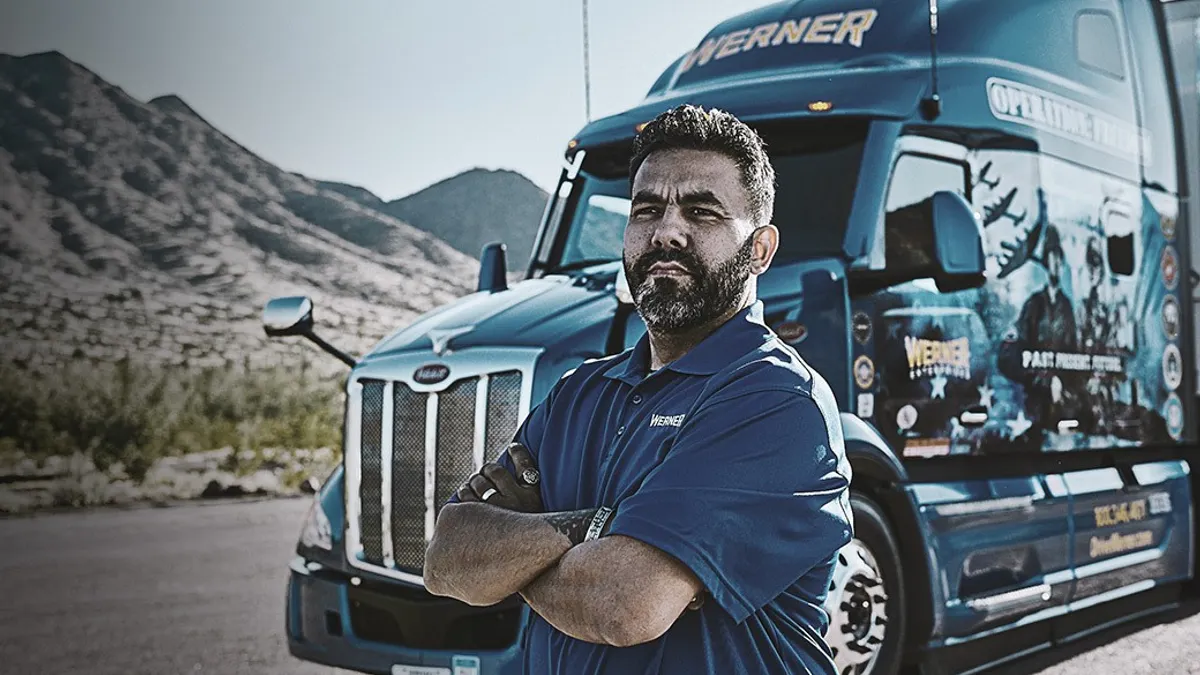
Team driving is a growing practice that benefits drivers, fleets and shippers. As carriers compete to recruit from a shrinking pool of qualified drivers, it’s become a way to attract talent. Werner®, one of the largest truckload carriers in the country, has heavily invested in its Team Driver Matching Program. “We’ve more than doubled our team-building rate,” says Jaime Jones, Senior Vice President of One-Way Transportation and Optimization at Werner.
Why Team Driving Pays
Federal rules limit each driver to 11 hours behind the wheel within a 14-hour on-duty window and require a 10-hour rest period in which a solo driver sits idle. A team driver can take that same 10-hour break in the sleeper berth while their partner drives, keeping the truck moving 20–22 hours a day and completing deliveries sooner.
“Team drivers are sought after to haul high-priority, valuable and time-sensitive freight,” Jones says. “Teams often keep the load in continuous transit, which heightens security for critical products.” That’s why teams are more likely to be offered retail, pharmaceutical and high sensitive freight contracts with predictable routes and performance bonuses.
Team driving pays a discounted per-mile rate, but for the entire journey, not just the miles personally driven. So while one partner sleeps, both are earning. Driving a combined 5,000–6,000 or more weekly miles nets each team member a higher paycheck than standard solo earnings. “You’re going to make more money — that truck is constantly running,” says Bobby, a long-time Werner driver.
Team drivers can each get to six figures early in a trucking career. In Werner’s tiered pay structure, new team drivers earn $60,000 to $93,500 in their first three months, backed by a $1,150 guaranteed weekly minimum. Pay can increase at three and nine months, reaching $77,000 to upwards of $130,000 per driver.
The Family Plan
Long-haul trips can sometimes be difficult for drivers, so some opt to tackle their routes with a partner they already know. Husband-and-wife, couple or family teams share experiences, coordinate vacation time, cut down on idle time and split expenses on the road, while potentially earning a combined household income of $200,000 or more
No Partner? No Problem
Werner runs a matching program that pairs drivers through a short survey on schedule, experience and what they want in a teammate, then connects compatible drivers in the same area once both confirm interest. If a match doesn’t work out, drivers can request a rematch. “Often the teammate knows even more about what they are looking for in a co-driver at that point,” Jones says.
“I was sent a list and got to call each one and interview them. I decided to team with Bobby because he’s been with the company 15 years,” says Christine, who joined Werner in 2023. “I wanted to learn and was hoping to get someone with more knowledge, so I was happy to get Bobby.”
An On-Ramp for Women
Team driving offers an appealing entry point for women into long-haul trucking. “I would definitely recommend teaming, especially for anybody starting out,” says Aisha, who works with her colleague Brenda. “It just makes you feel a bit safer.” Christine agrees: “I wanted to go teams because I wanted the protection of another driver out there.”
Historically, women have made up just 7–10% of CDL-holding professional truck drivers, according to the Women in Trucking Association’s WIT Index, but it doesn’t have to stay that way: The American Transportation Research Institute (ATRI) found that female driver representation in fleets running women-specific recruiting/retention programs was about 3 percentage points higher than at other carriers.
Aisha and Brenda were matched through a Werner program for women and have become friends as well as teammates. The company also focuses on safety features such as door straps and full cab curtains, plus a pet policy that lets drivers bring dogs along. The success of the programs is obvious: 13% of Werner’s driver workforce is female.
Broadening Horizons
Long-haul routes — like that 2,000-mile run from LA to Atlanta — give team drivers a chance to explore terrains and climates and handle more freight types, breaking up the monotony solo regional drivers can face.
In the long term, drivers who work with top-tier accounts can move into a specialized team fleet. “Drivers also have clear pathways for growth by becoming a Driver Leader, moving into roles like Werner Road Team Captain or Driver Ambassador,” Jones says.
Compounding Benefits
Team driving pays off for drivers, fleets and customers. “It’s a fantastic opportunity for new drivers who are anxious about being out on the road by themselves, or who just want a friend or a companion,” says a Werner team-matching representative. “It can get lonely out there, and this is an excellent way to break into trucking and get some experience on your resume in a safe manner.”