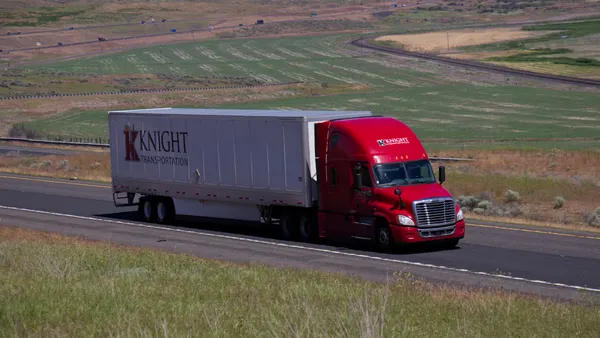
AAA Cooper Transportation’s national network is facilitating better industrial freight, securing heavier and longer loads, parent company Knight-Swift Transportation Holdings told investors Wednesday.
Tonnage per day grew 4.1% on a 5.2% increase in weight per shipment, the company reported for its Q1 earnings of the company’s LTL segment. Length of haul grew 8.5%.
“We saw a notable improvement in weight per shipment for the first time in years with this measure progressively growing throughout the quarter,” Knight-Swift CEO Adam Miller said on an earnings call. “This is a result of bringing on more industrial customers who can leverage our expanded network footprint to move heavier and longer length of haul shipments.”
Shipments per day were down 1% year over year to 23,349, according to an investor presentation. That was largely due to winter weather disruption in January, CFO Andrew Hess said. Revenue per hundredweight, excluding fuel surcharge, fell slightly, and renewal rates experienced mid-single digit increases, Hess said.
LTL revenue, excluding fuel surcharge, increased 2.6% year over year, the company said. Nevertheless, the company posted an operating loss in the segment of nearly $3.6 million for the quarter along with Q1 adjusted operating income of $1.2 million.
Claims development brought an $18 million hit, primarily due to an adverse ruling arbitration ruling on a 2022 claim, the company said.
That improvement follows the company’s 2024 acquisition of the LTL division of Dependable Highway Express, integrating those California and western U.S. assets, and rebranding its LTL carriers under AAA Cooper.
“We believe we are in the early stages of our network transition from regional to national,” Miller said.
Hess said the company’s expanded service coverage and presence in markets is helping the carrier as it shifts its freight mix from regional to national.
“We are encouraged by emerging seasonal freight patterns, steady progress on rate renewals, accelerating volume trends late in the quarter and an improvement in weight per shipment for the first time in years,” Hess said, “as freight mix continues to develop into our expanded terminal network.”