Dive Brief:
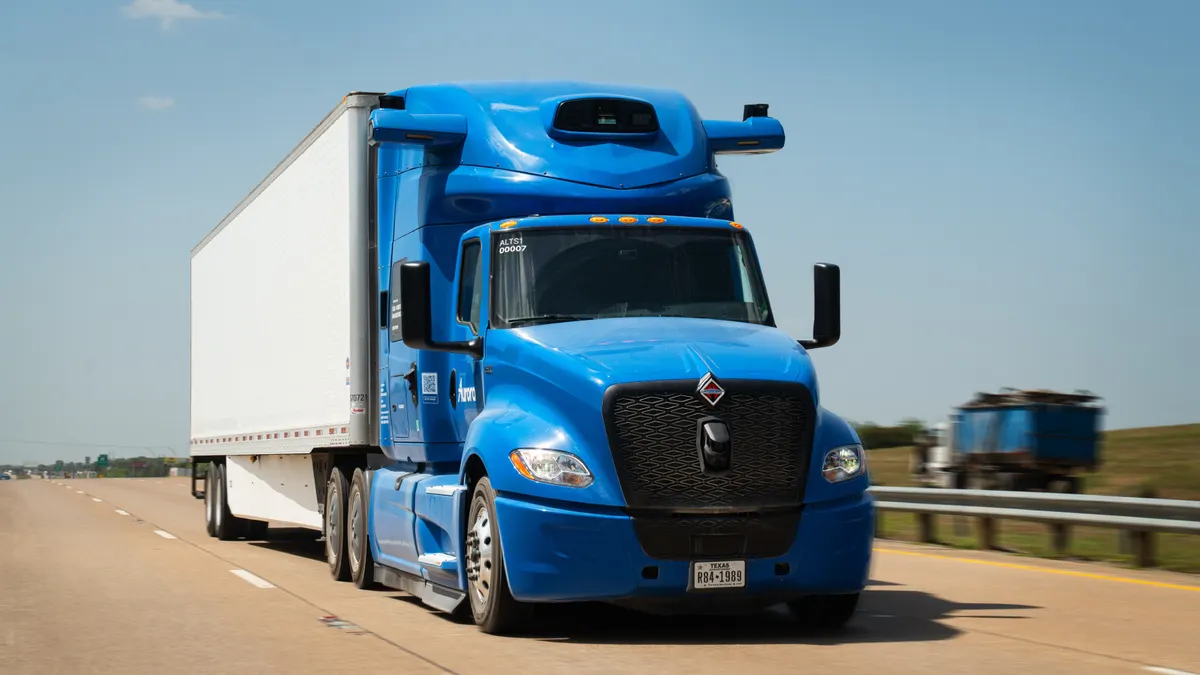
- Aurora Innovation is targeting more than 30,000 driverless trucks and more than $5 billion in revenue by 2030, the company announced Sept. 23.
- Aurora expects to exit 2026 with 200 trucks in operation, then will surpass 1,000 trucks and $200 million in revenue in 2027. It projects positive free cash flow on a run-rate basis by 2028 with 7,500 trucks on the road.
- Growth will come from Aurora’s Driver-as-a-Service model, in which carriers own and operate the trucks and pay $0.85 or more per mile. Aurora plans to cap its all-inclusive Transportation-as-a-Service model at about 500 trucks because it is much more capital intensive, SVP and CFO David Maday said during the company’s investor day.
Dive Insight:
CFO David Maday said 30,000 trucks may sound like a lot, but the figure is modest given that more than 2 million trucks are on U.S. roads today. By 2030, Aurora expects to be operating in a market of 150 billion vehicle miles traveled, out of roughly 200 billion in U.S. trucking.
“It is not an ambition. It is our target, right? And we're moving towards that,” Maday said days later at Evercore’s ADAS, AV & AI Forum. “I don't want to say it's 50-50 because it's kind of hard to say what's 50-50 out in 2030, but it is a realistic number. I know it sounds like a lot.”
Some targets have shifted. Aurora now expects positive gross profit on a run-rate basis in the first half of 2027, later than its earlier end-of-2026 goal, which Maday attributed to slightly slower fleet ramp. Its long-term gross margin target is now 60% by 2030, compared to 70% it previously set for 2028.
“There is no reason we can't deliver outstanding gross margins and reach 70%, but there are some uncertainties out there of things that we have to do,” Maday said. “Frankly, there's been a lot of supply chain headwinds as well that we're accounting for and addressing. So it's just appropriately conservative.”
A carrier’s perspective
Maday acknowledged at the Evercore forum that some customers push back on Aurora’s pricing, though he said they understand the value. Werner, which already runs driverless loads with Aurora, says a gap remains.
Werner EVP and Chief Information Officer Daragh Mahon reflected at the latest investor day what the carrier’s thinking was 2.5 years ago: The biggest questions were around technology, safety and reliability. Now, the remaining work is on the contracts and more significantly, economics.
“We’ve got to figure this out,” Mahon said, noting that the company is actively negotiating on the costs. “I think the economics become viable at scale, I mean, really viable at scale where nobody is eating some of the cost. And I don’t think that’s too far ahead of us.”
Werner sees long-haul, middle-mile runs of 500 to 2,000 miles as the best fit.
“There’s places that we find it hard to hire drivers to do certain middle-mile routes that are long, lonely roads,” Mahon said. “We think that’s where this really comes in.”