Dive Brief:
- The Federal Motor Carrier Safety Administration is seeking to officially exempt out-of-service penalties regarding English language proficiency in U.S.-Mexico border commercial areas, based on a proposed rule. A proposal is slated for official publication on Monday.
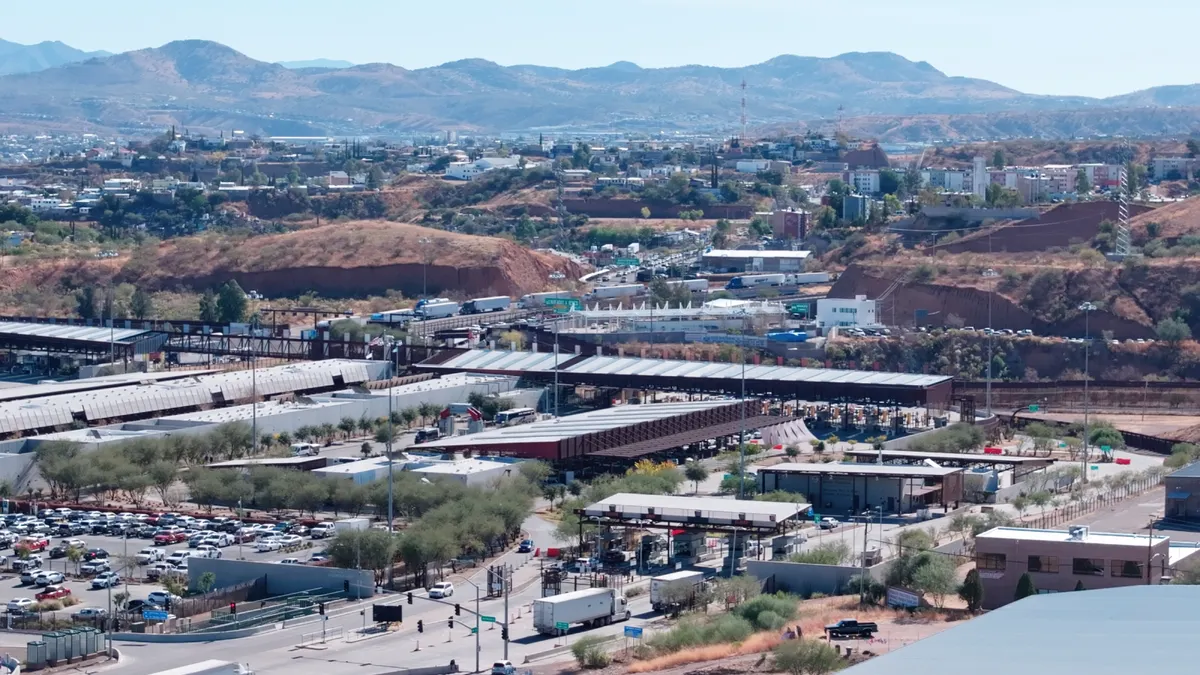
- The notice of proposed rulemaking codifies an April 2026 memo that clarified its English language proficiency enforcement. In the memo, the agency said the out-of-service penalty does not apply to drivers operating solely within defined border commercial zones, and it gave guidance on how to administer the policy.
- “This exception would not apply when there is evidence that the driver intends to operate, or has been operating, a CMV in the United States outside the border commercial zones,” this FMCSA said in its proposed rulemaking.
Dive Insight:
The agency’s April 2026 memo, along with its 2025 standards, state that “Federal inspectors” should not place drivers out of service if the driver remains in U.S.-Mexico border commercial zones.
FMCSA’s April 2026 policy and proposed rule call for agency enforcement personnel conducting inspections within a U.S.-Mexico border commercial zone to “determine the scope of the driver’s current trip before determining whether to issue” an out-of-service order under an English language proficiency violation, the notice states.
The April 2026 guidance “clarifies how the exception for drivers stopped in a border commercial zone should be applied, noting that drivers stopped in a U.S.-Mexico border commercial zone whose current trip would not involve transportation in the United States outside of the U.S.-Mexico border commercial zones should be cited, but not placed out of service,” Commercial Vehicle Safety Alliance Deputy Executive Director Adrienne Gildea said in an email to Trucking Dive.
The guidance gives a few examples to clarify how the out-of-service criteria applies:
- If a driver is operating solely within a commercial zone within the U.S.-Mexico border — such as moving a load from Laredo, Texas to Nuevo Laredo in Mexico — an ELP violation does not justify an out-of-service penalty.
- However, if a driver is operating outside of such a zone — transporting cargo from Laredo, Texas to Detroit, Michigan; or from Nuevo Laredo in Mexico to San Antonio, Texas — a driver could be placed out-of-service for an ELP violation.
The government’s standards further detail how bills of lading, dispatch records and other shipping documents can help inform those assessments.
The existing English language proficiency regulation requires that commercial drivers “read and speak the English language sufficiently to converse with the general public, to understand highway traffic signs and signals in the English language, to respond to official inquiries” and meet other objectives. Violations of the regulation can lead to out-of-service penalties, per 2025 FMCSA guidance directed by a White House executive order.
In advocating for the proposed rule, the agency estimated that unnecessary downtime can cost a fleet as much as $800 per day. FMCSA projected that the measure could save commerce some $14 million per year based on an estimated 9,000 drivers no longer being placed out of service.
Federal officials said in the notice that the proposed rule is simply codifying existing policy and also aligning with the CVSA’s North American Standard Out-of-Service Criteria that was revised with “enforcement tolerances” in an April 19, 2026, revision.
The FMCSA rule alignment is reflective of its own policy, even as it incorporates CVSA’s broader support. On April 19, 2026, CVSA’s board of directors voted to revise its OOS criteria by replacing a reference to the FMCSA’s May 2025 policy memo with a reference to “current FMCSA enforcement guidance,” the agency’s proposed rule said.
“By turning this guideline into a codified rule, future administrations will not be able to weaken ELP requirements,” the Department of Transportation said in a news release.