Editor’s note: This is the first part in a four-part series about NACFE’s Run on Less – Messy Middle demonstration and findings about ways to decarbonize and improve fuel efficiency.
Compressed natural gas is bringing big cost savings to a New Jersey-based waste collection fleet, which recently noted how it’s averaged $1.92 per diesel gallon equivalent over the last year.
“We just pull it directly out of the natural gas transmission line,” ACUA President Matthew DeNafo told Trucking Dive. “The biggest benefit is really the stability of gas pricing.”
The Atlantic County Utilities Authority has run on the cheaper alternative fuel since 2010, preventing over 11,746 metric tons of carbon dioxide equivalent from entering the atmosphere, the organization noted in a news release.
With average diesel rates skyrocketing in March and reaching $5.64 per gallon on average in early April and again in May, case studies such as the Run on Less – Messy Middle demonstration by the North American Council for Freight Efficiency show how companies can potentially save money following higher acquisition costs and also maximize efficiency, even with traditional diesel setups.
Real-world evaluations
The latest Run on Less – Messy Middle event, conducted in September 2025, evaluated 13 fleets in real-world routes under normal operations, covering powertrains that also included battery-electric vehicles and hydrogen fuel cells. NACFE released an executive summary and 274-page report in March. (The Atlantic County Utilities Authority was not part of the study.)
Optimized, modern diesel equipment can routinely deliver 10 to 12 mpg on flat or lightly rolling terrain as well as 8 to 10 mpg in heavily mountainous regions, the demonstration showed. That’s a sharp distinction from the industry average of 6.852 mpg in 2024, according to an American Transportation Research Institute operational costs report.
But the report also noted that compressed and renewable natural gas vehicles represented “the most mature alternative fuel technology currently in widespread commercial deployment.” Performance was comparable to diesel-powered trucks, and the Cummins X15N 15-liter natural gas engine, used in all of the CNG operations studied, also expands the market in long-haul applications, the report said.
CNG tractors with double and triples show capabilities
In diverse operating environments for three businesses showcasing CNG trucks, there were theoretical ranges of approximately 800 and 1,200 miles across Peterbilt 567, Kenworth T680 and Kenworth T880 trucks.
"The fleet feedback and performance achieved by the new 15-liter natural gas engine highlights this as an excellent choice that competes well with equivalent diesels in difficult, heavy-haul duty cycles,” NACFE said in its report.
CNG’s field performance numbers
The demonstration aimed to show how trucks are actually performing, as opposed to projections or manufacturer claims, NACFE said, adding that fleets aiming to decarbonize might be going on a multi-decade process that doesn’t rely on any one particular powertrain.
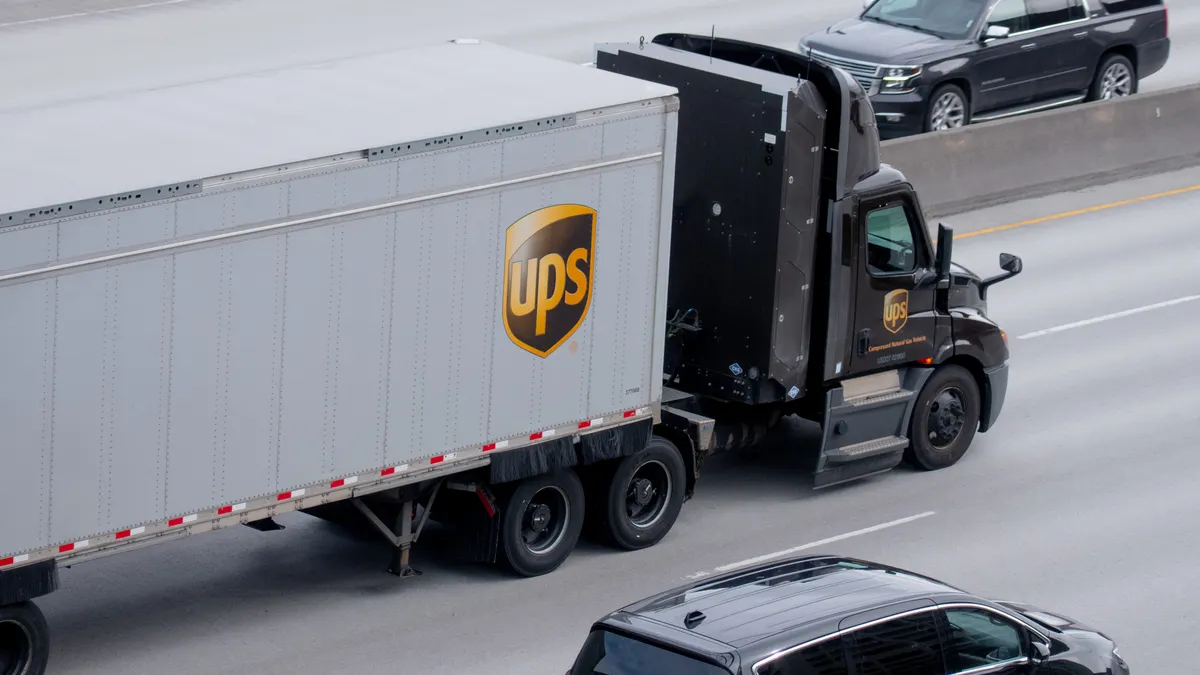
To evaluate the trucks, NACFE placed a telematics device on vehicles. That involved a triple-trailer out of UPS’ Salt Lake City, Utah, hub, where over half of linehaul tractors are CNG, operating in a mountain-basin region; a Kleysen Group CNG tanker in Alberta’s prairie and foothill corridors traveling approximately 250 to 576 miles per day; and a truck from one of Wegman’s 197 CNG tractors for a regional grocery route.
Notably, fuel efficiency results showed that:
- Wegmans achieved a 5.3 miles per diesel gallon equivalent on flat ground, which was in the “mid-2s” under steep grades with 140,000 pounds in hilly terrain in Upstate New York
- Kleysen achieved about 5.0 miles per DGE when traveling above 60 mph, demonstrating “true heavy-haul highway work,” NACFE said, under a gross combination weight of approximately 110,000 to 140,000 pounds
- UPS’ triple-combination CNG T680 spent about 90% of mileage above 60 mph, and with those speeds, it achieved a roughly 7.2 miles per DGE
“Natural gas has proven itself winter after winter for us in New York ... hauling very heavy doubles through hilly country and seeing diesel-like performance,” Matt Harris, fleet maintenance manager for Wegmans Food Markets, said in the report.