Dive Brief:
- Schneider National’s Q1 income from operations fell 21% year over year to $33.4 million in “a quarter marked by disruptive weather and fuel volatility,” President and CEO Mark Rourke said in an earnings release Thursday.
- Execution of cost and productivity actions as well as a diverse, nimble portfolio aided the company in keeping YoY quarterly revenues mostly flat at $1.4 billion, per the release.
- But Rourke noted the carrier’s disciplined approach of operating efficiently has positioned the company to capitalize on an improving business environment showing “early cycle tailwinds.”
Dive Insight:
Rourke, in his final earnings call as CEO before transitioning to executive board chairman July 1, credited the company’s technology investments and productivity improvements as part of a broader effort that helped the carrier through a prolonged weak freight market.
Now with signs pointing to improving economic conditions and more carriers exiting the marketplace, Rourke said “as freight fundamentals continue to move back to more rational conditions, we expect the benefits of the actions we took to structurally improve the business will be increasingly evident.”
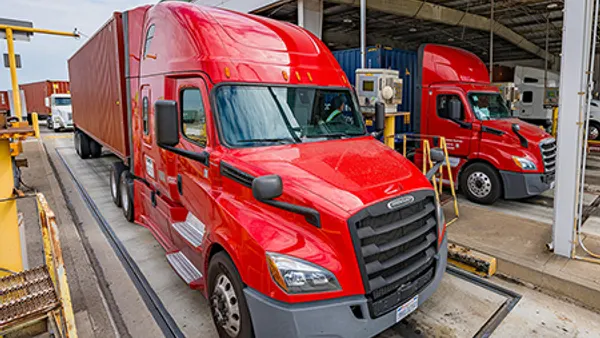
Improved network productivity contributed to a 1% ($4.3 million) YoY improvement in Schneider’s truckload Q1 revenue of $618 million, despite lower dedicated freight volume, the company said. Truckload quarterly revenue per truck per week increased 2% or $98 to $4,051.
Income from operations for the segment totaled $20.2 million, down 20% YoY.
Higher maintenance costs and increased fuel expenses led to an increase in the carrier’s truckload operating ratio, which was 96.7% for the quarter compared to 95.9% a year ago.
Growing its truckload business has been a focus for Schneider which has expanded the segment through acquisitions, most recently with its purchase of Cowan Systems in December 2024.
Rourke said driver capacity will be a constraint as supply tightens, which should generate incremental dedicated demand.
“As freight fundamentals continue to normalize and capacity rationalization progresses, we are more ready than ever to benefit from improving cycle dynamics,” he said.