Dive Brief:
- New rules adopted by California remove a ban on driverless trucks weighing 10,001 pounds or more from operating on public roadways, clearing the way for autonomous freight operations in the state, the Department of Motor Vehicles announced April 28.
- The regulations update the department’s rules on autonomous vehicles and are intended to enhance safety, oversight and enforcement, per the release.
- “These updates support the growth of the AV industry by enhancing public safety and transparency while adding additional accountability for AV manufacturers,” California DMV Director Steve Gordon said in the announcement.
Dive Insight:
California joins a growing national movement, which has seen several states advance testing and commercial deployment of autonomous vehicles on public roads.
States including Texas, Arizona and Michigan already allow self-driving freight deliveries on public roads without a safety driver in the vehicle while many states have varying degrees of what’s allowed. The Autonomous Vehicle Industry Association highlights the Southern U.S. as a top area for AV expansion given state regulations.
The California DMV said safety was a priority for the agency in adopting the new AV rules. The state said the new rules were officially adopted with certain provisions effective April 28 and others to be phased in over the coming months.
Under the new rules for trucking, manufacturers are required to conduct AV tests using a safety driver and progress to driverless testing before applying for commercial deployment.
Manufacturers must complete 500,000 miles for heavy-duty trucks during two separate phases for a total of 1 million miles and prepare a structured safety case demonstrating the safety of vehicle hardware, software and operations, the state said in the announcement and in a report.
Standards also have been established for remote operations personnel, including licensing qualifications, permitting and training requirements for remote drivers and assistants, the state said.
Autonomous vehicles are also now subject to moving violations, the state said. The rules establish a process for law enforcement to issue notices of AV noncompliance to manufacturers when a self-driving vehicle commits a moving violation.
California’s decision to adopt new AV deployment rules was welcomed by the industry.
Earl Adams, former Federal Motor Carrier Safety Administration deputy administrator and chief counsel who is now an executive with AV firm PlusAI, said in an email to Trucking Dive that California’s move establishes a clear path to commercialization.
He said because California is home to some of the nation’s largest ports and its agricultural products are distributed domestically and globally, “enabling autonomous autonomous trucks to operate here is about transforming how goods move at scale, unlocking new levels of efficiency, resilience and safety.”
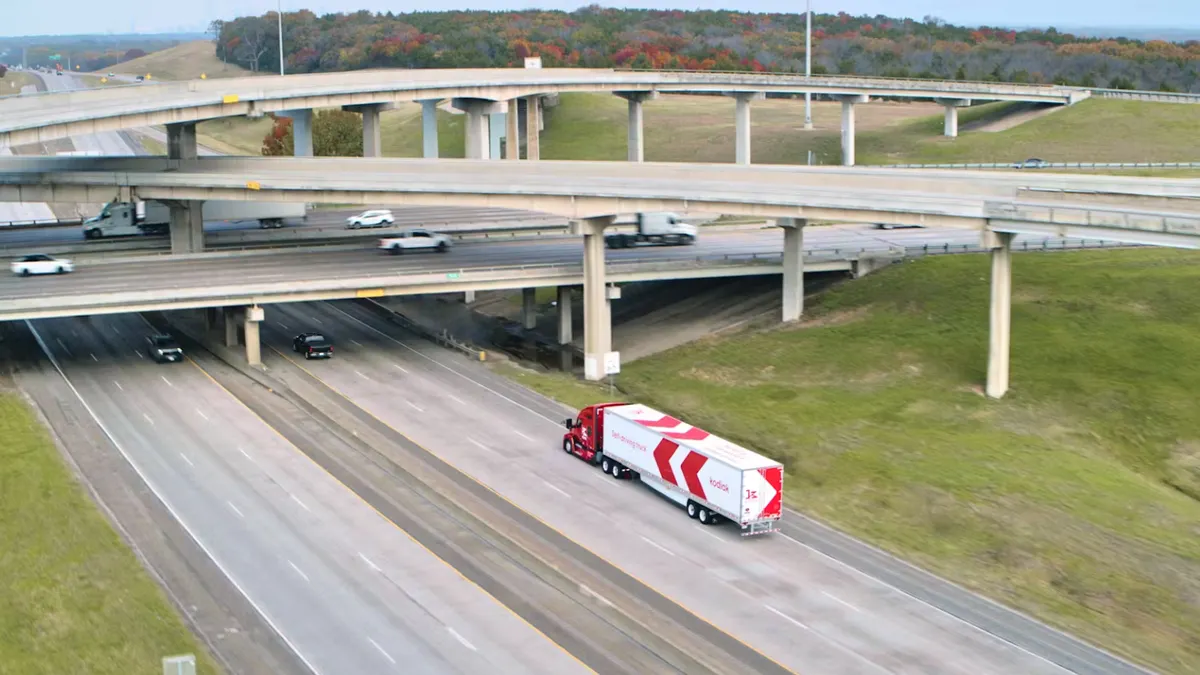
Daniel Goff, VP of external affairs for Kodiak AI, said in an emailed statement that the rules allow innovation to proceed, while also ensuring strong state oversight. The company is actively working to scale autonomous truck deployment.
He said now that California allows three types of permitting — testing with a safety driver, driverless testing, and driverless deployment — Kodiak can now seek a permit to operate in the state to haul goods using autonomous technology.
“It also gives us a path to driverless deployment, both in California and coast-to-coast,” Goff said.