Dive Brief:
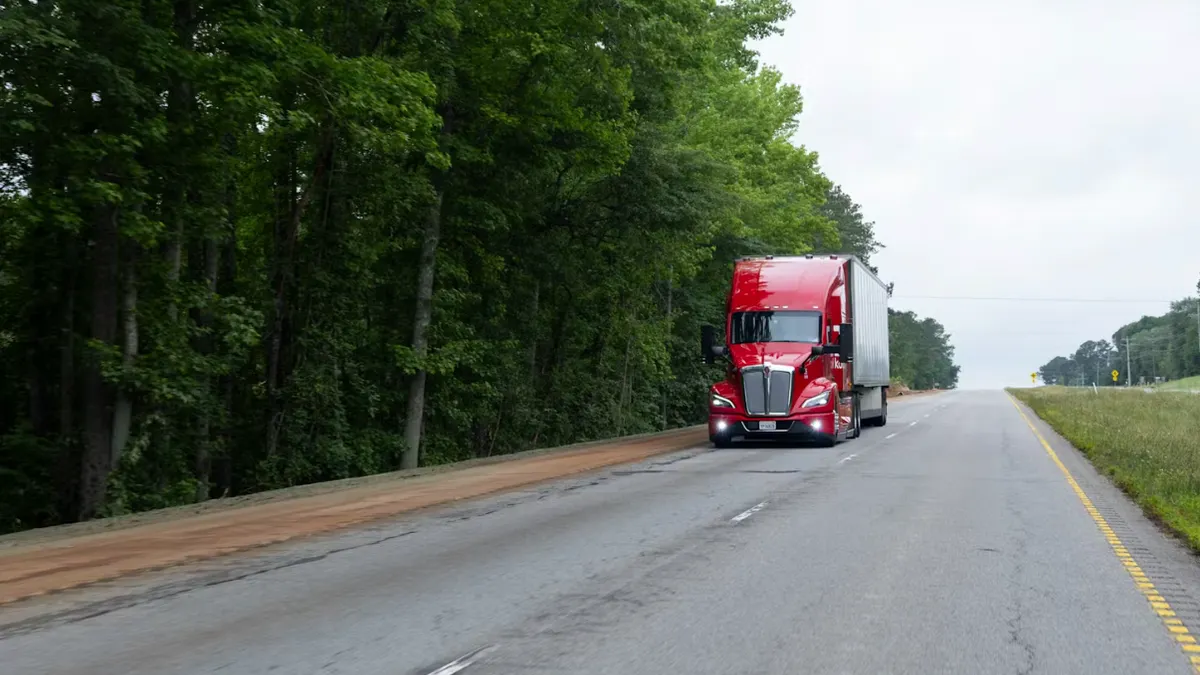
- Kodiak AI launched a new driverless route between Dallas and El Paso with logistics services provider Martin Brower, the company announced during a Q4 earnings call on March 10.
- It is the second route between the autonomous trucking tech firm and the food and beverage distributor. The companies began collaborating in 2022, which led to an autonomous route with a safety driver between Oklahoma City and Roanoke, Texas.
- “This new route represents a core tenet of our strategy of increasing our penetration with our existing customers,” CEO Don Burnette said on the call.
Dive Insight:
Driving growth with existing customers is part of Kodiak AI’s plan to widespread commercial rollout of its autonomous driving technology. The company reported Q4 revenue of $1.1 million, representing a 37% quarter-over-quarter growth.
Burnette said the launch of its new route between Dallas and El Paso brings its weekly operational lanes to eight. That comes as the company after the business emerged as a public company in September.
But more importantly, the route gives the company another route available to operate beyond current service hour limitations, he said. Burnette believes this creates opportunities with its targeted customer base with an aggregate fleet size of over 125,000 trucks.
“This deep customer base means that even with moderate penetration into our current customer fleets, we will have all the demand that we can service in the coming years,” he said.
Kodiak said in its earnings release that its long-time partner Atlas Energy Solutions now operates 20 trucks equipped with its technology, which represents 100% quarter over quarter growth. Burnette said the company remains committed to delivering 80 trucks to Atlas over the next few quarters, though the deliveries will be aligned with Atlas’ fleet planning and deployment schedule.
Additionally, Kodiak announced it launched a new pilot with “a major Fortune 500 private fleet” hauling freight between Dallas and Houston. Burnette added that his company is also exploring international markets, including Australia, Canada, and the Middle East, as well as remote industrial locations where companies face difficulties in recruiting and retaining drivers.
The company said trucks powered by its technology have delivered more than 12,600 loads, an 87% increase when compared to the end of 2024. Tractors using its technology have operated more than 10,700 cumulative hours without a human board through the end of Q4, per its earnings release.
Burnette said the company began testing at the American Center for Mobility Proving Ground outside Detroit in February. He said the facility allows the company to evaluate “rare scenarios under near real-world conditions at highway speeds,” adding the tests are another step toward a commercial launch later this year.
“We are entering 2026 with momentum, a clear execution plan and a capital-efficient business model designed to scale, drive towards profitability and generate free cash flow over time,” Kodiak CFO Surajit Datta said on the call.