Dive Brief:
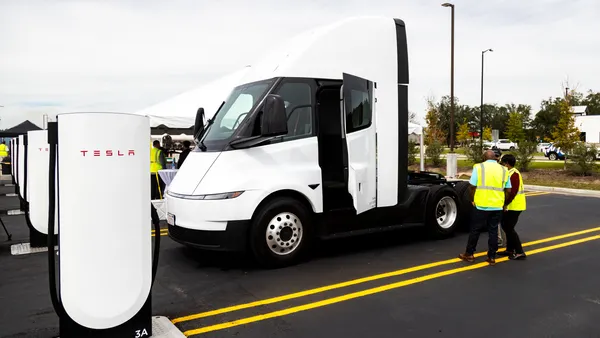
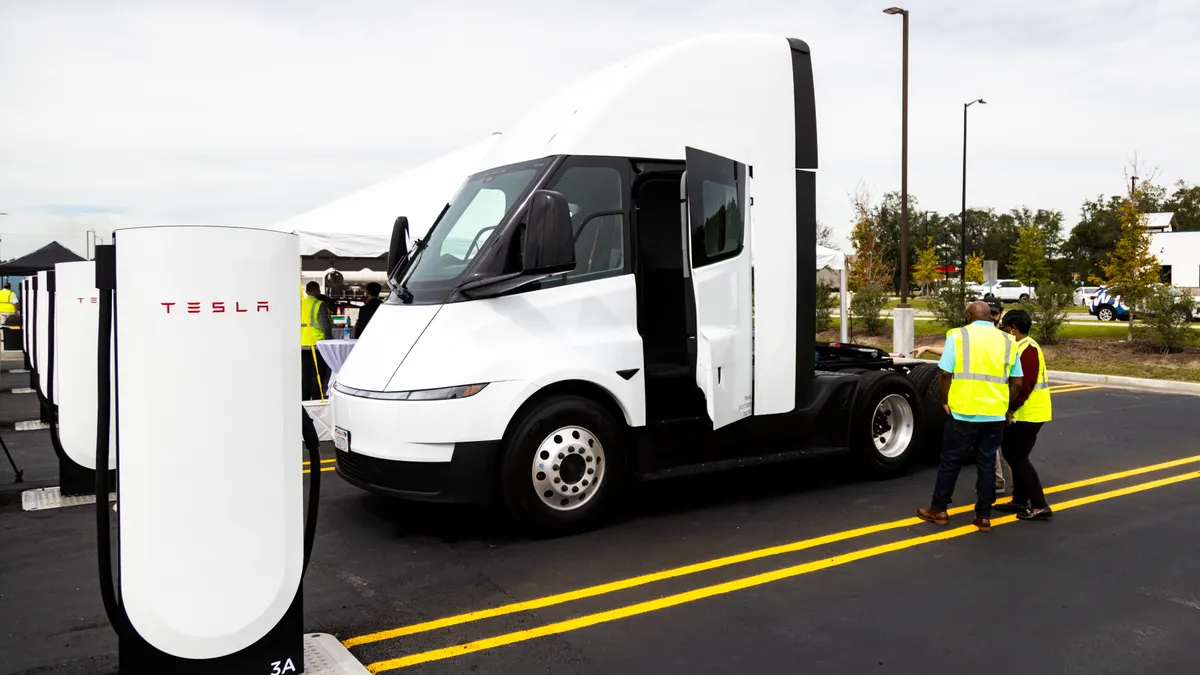
- Tesla and Pilot unveiled openings of Megachargers in Ellabell, Georgia, and Tulare, California, last week as part of a partnership to expand existing fueling sites with heavy-duty electric truck charging infrastructure.
- Those two sites and several others expected to come online soon have four to eight heavy-duty charging stalls as the OEM and travel center giant target electricifying major freight corridors, such as along I-5 and I-10.
- “With these initial locations, we’re making fleet electrification a more accessible option for long-haul transportation,” Shannon Sturgil, SVP of alternative fuels at Pilot, said in a news release Thursday.
Dive Insight:
Megachargers, targeted for heavy-duty Tesla Semi use, can provide “ultra-fast charging” with up to 1.2 megawatts of power, allowing a 60% charge to be recovered in 30 minutes, according to Tesla.
That’s markedly different than its established network of Tesla Superchargers for passenger EVs that provide power up to 250 kilowatts. But the Megacharger network has some catching up to do with the more expansive EV charging footprint.
Currently, only one other Megacharger is open in Georgia, which is located near Atlanta, with another two in the Southern California area by Los Angeles and San Bernardino, according to a Tesla map on its website. Dozens of additional sites are slated for California and Texas with additional openings planned in other states across the U.S.
Megachargers are not the only available charging options for heavy-duty electric trucks. Other active heavy-duty charging sites include WattEV’s site in Fresno, California, and We Realize’s semi-public site at the Las Vegas Motor Speedway, according to the nonprofit Catalyst Mobility, formerly known as CALSTART. The Fresno site is WattEV’s seventh.
“We’re excited to see the Northern California portion of our network coming together just in time for the arrival of the Tesla trucks,” Salim Youssefzadeh, CEO and co-founder of WattEV, said in a June news release.