Dive Brief:
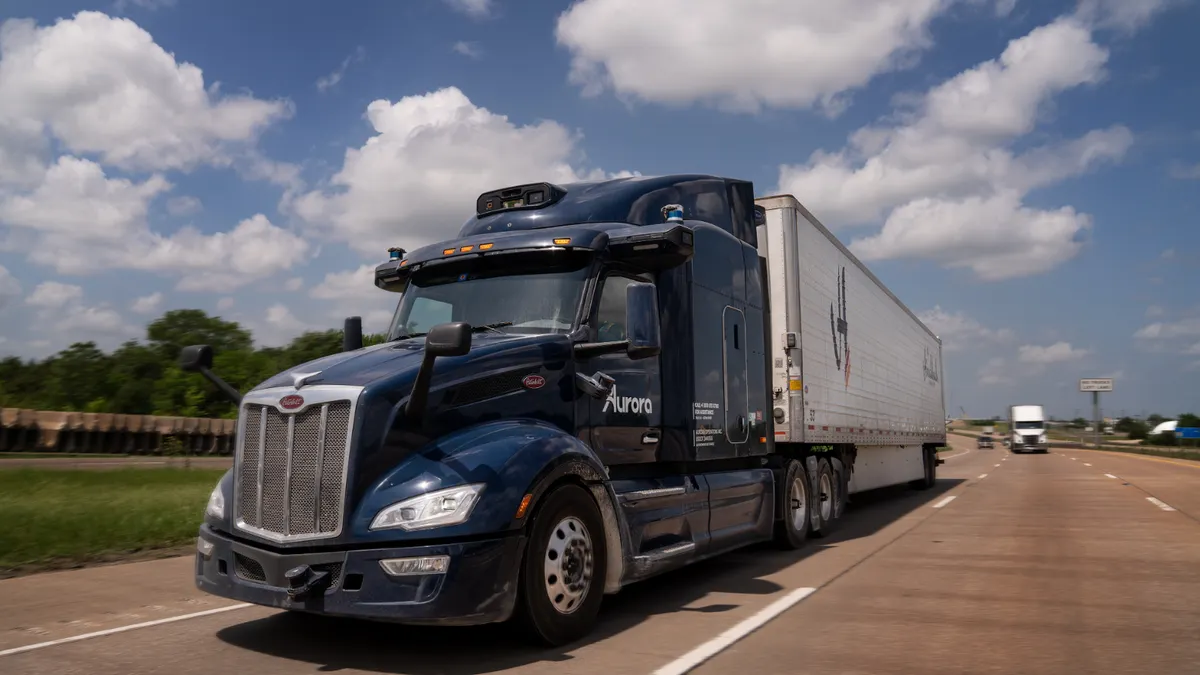
- Aurora Innovation’s transition to commercial scaling introduces improved autonomous technology produced at half the cost through its second-generation truck, company executives said on a call with analysts on July 29.
- “Crucially, we expect this kit to drive a 50% plus reduction in Aurora Driver hardware costs, a key lever supporting our breakeven gross margin target,” Chris Urmson, co-founder and CEO said in the call.
- Between 20 and 25 autonomous trucks are expected to be in service in Q3, Urmson said. But manufacturing partner Roush is on track to reach an annual production rate of 1,000 trucks in October.
Dive Insight:
As Aurora Innovation advances scaled production, the company is also on track to have more than 200 driverless trucks in operation by the end of the year, CFO David Maday said in the call. Eventually, with all trucks in operation, that means Aurora could generate $80 million in revenue each year through transportation-as-a-service agreements. This year, since not all trucks are in operation yet, Aurora expects to make between $14 million and $16 million in revenue, according to its shareholder letter.
Securing more TaaS arrangements is a good sign for autonomous trucking, according to TD Cowen analysts.
“New customer TaaS wins help accelerate the commercial flywheel and signal robust demand for autonomous trucking solutions,” TD Cowen analysts wrote in an investor note. The analysts noted that Aurora executives said that current TaaS customers intend to migrate to Driver-as-a-Service agreements in 2027, which are more lucrative.
Through DaaS arrangements like Aurora has with Hirchbach, customers have control and ownership of assets, which allows them to maximize total cost of ownership savings, according to the autonomous tech firm. While Aurora, won’t own those vehicles, the company earns revenues through Aurora Driver subscription services as it evolves into a high-margin and capital-efficient business, per a May press release.
TD Cowen analysts added recently announced partnerships with Charger Logistics and Value Truck, “not only validate Aurora’s technology but also signal growing industry confidence in autonomous trucking solutions.”
Aurora said in a shareholder letter that supporting accelerating customer demand meant advancing the company’s hardware and autonomy-enabled truck programs. Technology advancements include performance gain, a more efficient computer, and improved long-range lidar, which combined deliver more than 34 seconds of reaction time at highway speeds.
“It's really important to understand the level of rigor and testing we put these systems through to achieve the durability we intend to get out of them,” he said on the call. “We've been testing these units for months already, and we'll continue to test them forward so we can continue to build confidence in them.”
The company said its first generation technology installed on Peterbilt trucks will be phased out, Urmson said. Aurora’s new technology will be featured on International trucks and those produced and utilized by Volvo Autonomous Solutions. Volvo also announced scaling plans and its intent to remove safety drivers and go fully driverless in Q1 2027.
Continuing to evolve its technology is part of Aurora’s strategy, Urmson said.
“We've already begun some of the reliability testing for the third-generation hardware components,” he said. “So this is work that is in flight and gives us a lot of confidence on what we can expect going forward with the fleet.”
Clarification: This story was updated to clarify Aurora's expected revenue in 2026, and how it may change in the future with all trucks in operation.