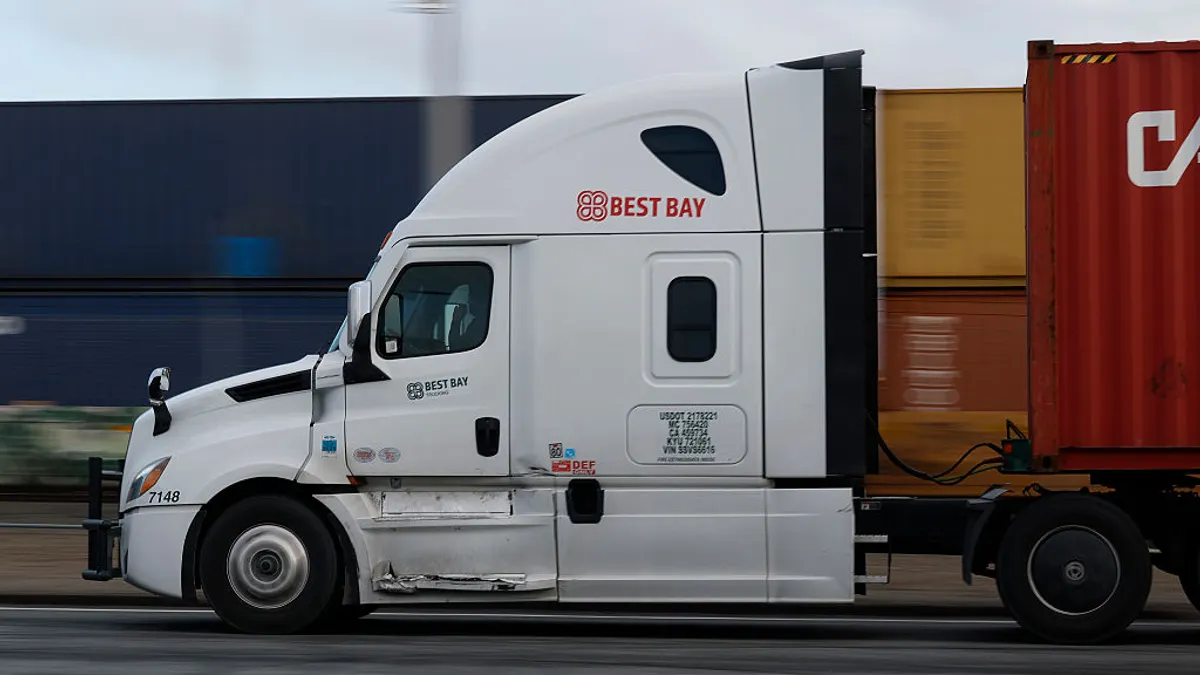
The Labor Department’s announcement Thursday that a new final rule on how independent contractors are classified is viewed by trucking organizations as a victory for owner-operators whose livelihoods will continue as it has for decades.
As the final rule focuses on a weighted economic reality test, including a worker’s degree of control over their work, trucking groups say it preserves independent contractors’ ability to set their own work schedules and operate like a stand-alone business. The American Trucking Associations in a statement added the final rule brings “clarity and order to the law in this area.”
“Many truckers prefer this pathway to entrepreneurship because of the flexibility and freedom it provides, giving them the ability to run their own businesses, set their own hours, and chart their own routes,” Henry Hanscom, ATA chief advocacy and public affairs officer, said in a statement.
That’s how Emily Plummer, a self-employed owner operator who has driven for Missouri-based Prime Inc. for nearly three decades, sees it. Last year, she met with Labor Department officials through ATA’s Women in Motion group, where other owner operators discussed the importance of preserving the independent contractor model.
“Being an independent contractor gives me the power to choose my own routes and control my own schedule,” Plummer, who started driving for Prime in 1999 at age 22, said in the statement.
Todd Spencer, president and CEO of the Owner-Operator Independent Drivers Association, said in an emailed statement that the Labor Department’s decision was “a step in the right direction,” but he noted “it will take time to review a rule this complex and understand its full impact on our members.”
Spencer welcomed the Labor Department’s continued acknowledgment that speed limiters are not a mandated safety device and other provisions that may help truckers in perceived predatory lease-purchase arrangements.
“With that said, the effectiveness of this regulation will be determined by how its details are interpreted and enforced,” Spencer said.
While trucking groups expressed optimism over the final rule, groups including the Society of Human Resource Management noted the simplified federal classification does not override state laws including California’s AB5 law, which requires independent owner-operators to be reclassified as employees. The organization noted employers should review existing contractor relationships.
“Maintaining documentation of actual working arrangements and monitoring applicable state requirements will remain essential to reducing misclassification risks,” the human resources group said.
The final rule is no surprise after the Labor Department shared a proposal on the move in February. Administrations frequently differ on how the regulation should be applied, the law firm PilieroMazza previously noted.
“President Biden’s DOL promulgated an employee-friendly rule [in 2024] that moved away from simple economic reliance and took into account several balancing factors,” the law firm noted, adding how the Trump administration’s “DOL ordered its agents to stop enforcing that rule” in May 2025.
The new rule syncs with the approach that the department had introduced in 2021 under the final days of President Donald Trump’s first term. In explaining the 2026 rule, the department noted concerns about how under the 2024 rule, a business might unnecessarily classify an independent contractor as an employee due to ambiguities.
David Taube contributed to this story.