Dive Brief:
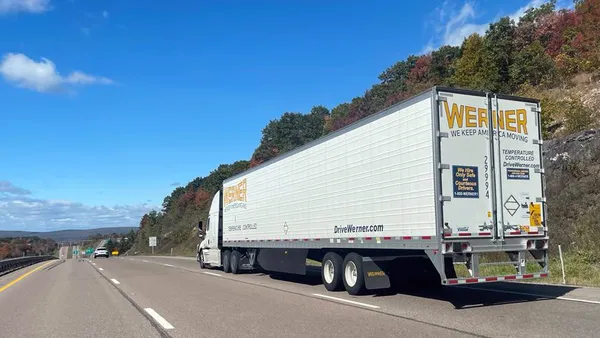
- Werner Enterprises reported Q3 revenues of $950.5 million, an increase of 23% or $179 million versus the same quarter last year, the company announced Tuesday.
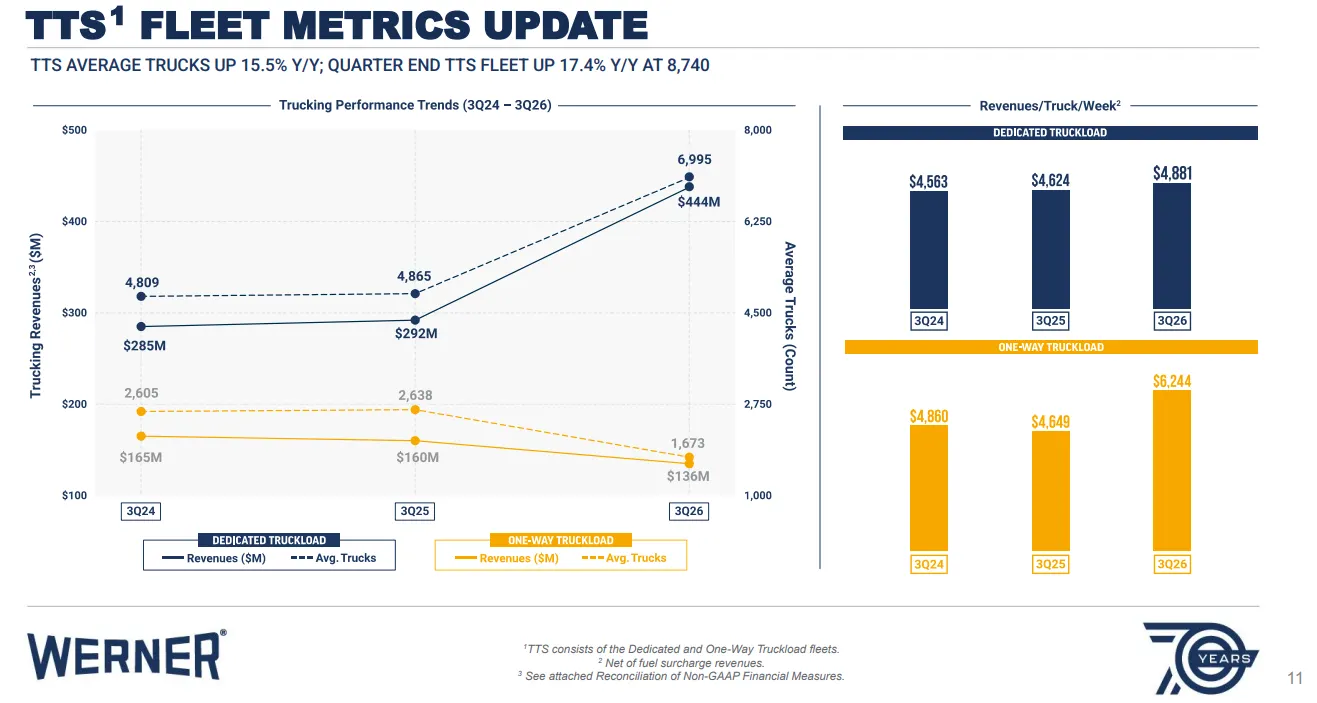
- The carrier credited the double-digit growth to high performance in its core Truckload Transportation Services segment, which saw revenues rise by $127.6 million, excluding fuel surcharge.
- In addition, the segment had more average trucks in service — 1,165 more — in the quarter, and revenue per-truck was up significantly. The larger fleet size was mostly due to its acquisition of FirstFleet earlier this year.
Dive Insight:
With Werner having restructured its one-way truckload business and increased capacity in its dedicated business, the company is focused on growth.
In the past year, Werner's one-way business has exited less profitable regional lanes and deprioritized commodity and short-haul freight in favor of higher-margin work, like expedited loads. Meanwhile, the company has also sought to expand its dedicated business with the acquisition of FirstFleet, which added over 2,000 trucks to the segment.
These efforts paid off for the carrier, which saw both total revenues and average revenue per truck increase in both segments.
Werner also saw increased profitability in the quarter, even as rising fuel costs and elevated claims offered some headwinds, according to the earnings release. Q3 operating income in its transportation services segment was $23.2 million, compared to a $13.8 million loss a year ago.
Chairman and CEO Derek Leathers said the operating income growth was a sign the company's "underlying strategy" is working, and gives credence to recent investment decisions.
"We made the deliberate decision to accelerate investments in driver recruiting and onboarding to capture rising customer demand and support fleet expansion as industry capacity tightens," Leathers said in the earnings release. "We remain confident in our trajectory and our ability to capitalize on the early stages of this freight upcycle.”
Leathers offered more detail on the type of upcycle he's expecting on a call with analysts Tuesday. He said that as inflationary pressure and rising interest rates continue impacting consumers, it could lead to more foot traffic at discount retailers, a segment where Werner is well positioned.
“Our strong footprint in discount, grocery and non-discretionary retail positions us well with retailers carrying leaner inventories, he said.
Leathers added that as the trucking industry continues to see attrition, Werner's investments to boost capacity will allow the company to pursue more business as demand grows.
However, that fleet growth may also come with higher expenses, such as a need to increase investments in drivers and higher exposure to diesel price volatility. Werner last week warned investors that a rise in insurance, driver and diesel fuel costs had led to higher costs in the third quarter of this year, compared to the second quarter.
Carriers have flagged assorted challenges concerning driver availability in recent weeks, including rising wages and regulators cracking down on CDL schools.
Werner raising concerns over drivers “speaks to the acute pressure carriers are facing,” TD Cowen said in an analyst note. Werner operates its own driver training schools, which provides a steadier flow of drivers versus carriers like J.B. Hunt Transport Services which does not, the banking firm said.
Despite its ability to train drivers, Leathers noted the company’s own program as well as other driver training programs have experienced enrollment declines ranging between 20% and 30%.
“That’s an ongoing battle to get people kind of interested in professional driving as an occupation,” he said on the call.
Though wages for drivers are attractive and have been increasing throughout the year, recruiting people to the industry remains challenging, Leathers said. Werner has worked to alter its network through the years, so that over “70% of the fleet” is home multiple times a week, he said.
A challenge, at least for Werner, has been getting the word out about how it's improving lifestyles for drivers, Leathers said.
“It’s about making the job increasingly attractive and changing the narrative on what used to be a go out over the road two to three weeks at a time,” he said.