Dive Brief:
- Aurora Innovation’s ability to deliver an 85-cent-per-mile operating cost is drawing interest from carriers, CFO David Maday said on a call with analysts Wednesday.
- With the company expanding routes and commercial rollouts, interest in the company’s driverless technology “has been picking up a lot over the last six months,” he said.
- “Frankly, the number of inbounds that we’re getting has been just increasing dramatically,” Maday said, adding that the company’s projected pricing enables the company to succeed and “support broad-scaled adoption for our customers.”
Dive Insight:
Aurora told Trucking Dive it anticipates deploying more than 200 driverless trucks without people behind the wheel by the end of the year. Maday said that will translate to $80 million in revenue by the end of 2026.
A spokesperson for Aurora said in an email to Trucking Dive the company currently has 30 trucks serving its driverless routes. Those routes validated for driverless operations are Dallas and Houston; Fort Worth and El Paso; El Paso and Phoenix; Fort Worth and Phoenix; Fort Worth and Phoenix; and Dallas and Laredo, the spokesperson said.
The firm expects revenue growth to continue into 2027 and beyond, driven by deepening relations with existing partners.
In the days leading up to its Q1 earnings release, Aurora announced April 30 an expansion of its partnership with Hirschbach Motor Lines, where the reefer carrier will own 500 driverless trucks operated by the tech firm’s technology.
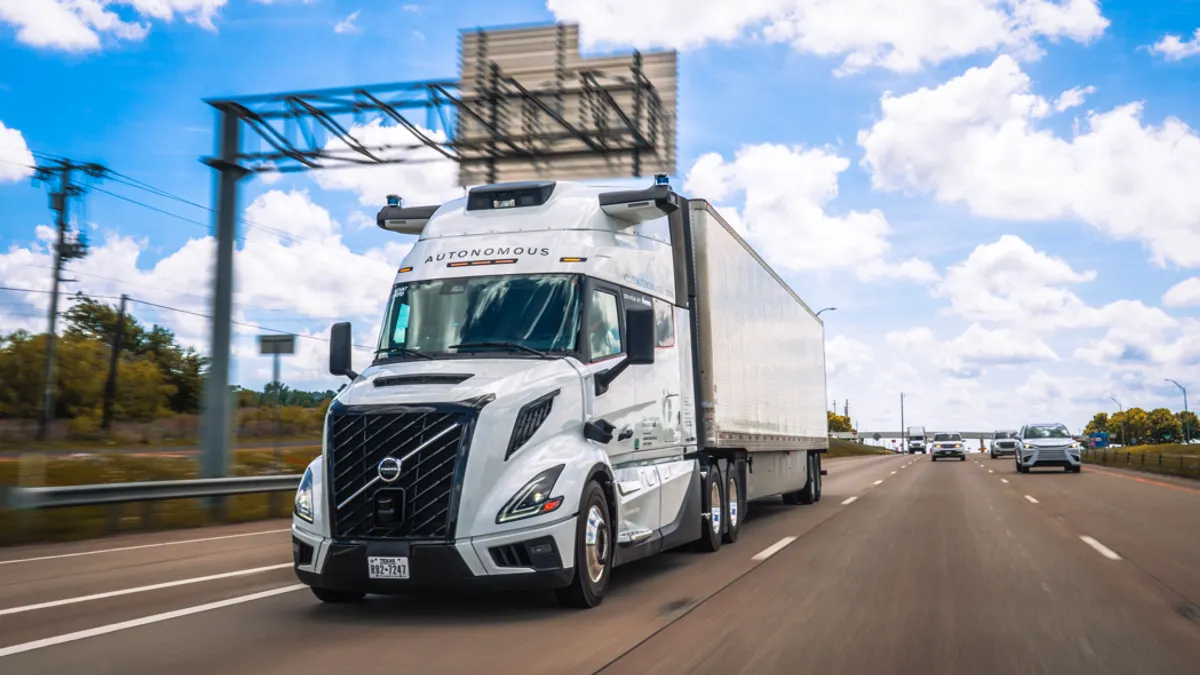
On May 4, Aurora announced a new 200-mile route between Dallas and Oklahoma City with partner Volvo Autonomous Solutions. Through that partnership, Volvo will haul freight autonomously to customer facilities, which will reduce the need for drayage moves and additional handoffs, according to the announcement.
That was followed by a May 6 announcement of a new autonomous route with McLane Company between Dallas and Houston with an observer on board. This agreement will expand to new routes between the food distributor’s facilities across the U.S. sun belt by year’s end.
Aurora and McLane began a supervised autonomous pilot in Texas in 2023 that has logged more than 280,000 autonomous miles and delivered more than 1,400 loads safely and 100% on time. This pilot included two round trips between Dallas and Houston, seven days a week, using a hybrid model where Aurora’s driverless technology handled the long-haul middle mile, while McLane drivers took care of the local deliveries to customer locations, according to the announcement.
Aurora’s growing public presence and commercial success is building interest, Maday said, adding that “part of it is just we’re out there and people can see and experience it more.”
During the annual Raymond James Institutional Investor Conference in March, Maday referenced the American Transportation Research Institute’s annual survey of trucking operational costs. The 2025 report noted the average cost per mile was around $2.26 — with driver wages and benefits costing about $1 per mile, he said during the investor conference, noting Aurora planned on setting an operating price “at about 85 cents a mile.”
This is where Aurora’s value proposition resonates well, Maday said on the Wednesday call with analysts.
“I think the customers themselves have been giving us really good and direct feedback,” he said. “We’re confident that we’re going to be able to grow the business and achieve our profit objectives.”