Dive Brief:
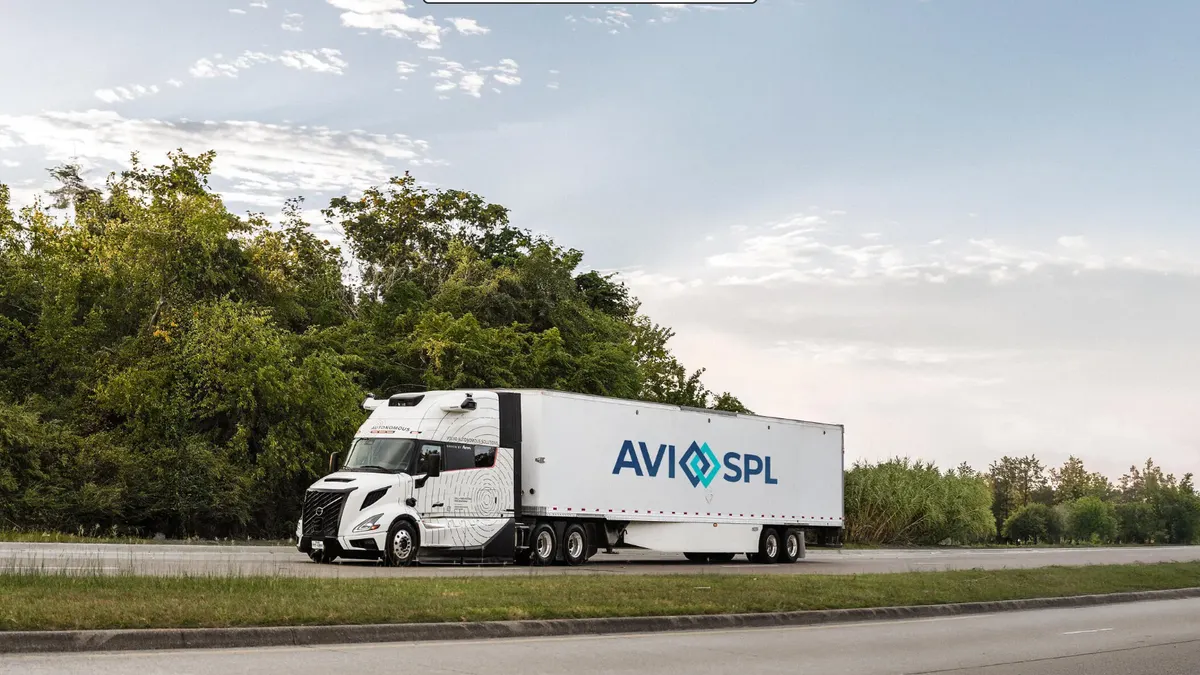
- Volvo Autonomous Solutions has launched commercial autonomous freight operations with technology firm AVI-SPL, serving a key route in Texas, the company announced June 18.
- The route between Dallas and Houston will transport assorted new audio-visual electronics and equipment designated for recycling and reclaiming precious metals for AVI-SPL, per the release.
- Sasko Cuklev, head of on-road solutions at Volvo Autonomous Solutions, said AVI-SPL’s use of autonomous transport allows it to move high-value goods with speed and responsiveness. “This collaboration shows how autonomous transport can help reduce transit times, improve service, and meet the demands of time-sensitive, high-value freight,” Cuklev added.
Dive Insight:
Volvo Autonomous Solutions’ new commercial route with AVI-SPL advances the Volvo Group subsidiary’s plan to remove safety drivers and go fully driverless on U.S. highways in Q1 2027.
The new route utilizes Aurora Innovation’s autonomous technology in the Volvo VNL. But that’s not the only route in Texas the companies are focused on: In May they launched a new 200-mile AV route between Dallas and Oklahoma City.
AVI-SPL’s route between Dallas and Houston will have a safety driver on board until it closes the safety case for the truck being used, a spokesperson for Aurora said in an email to Trucking Dive. Aurora has said previously its goal through its partnership with Volvo has been to bring autonomous freight to scale.
Volvo expects to be operating more than 300 autonomous trucks on U.S. highways by the end of 2027, followed by industrial scaling in 2028.
AVI-SPL said its driverless route reflects its commitment to operational innovation and supply chain strategies designed to improve scalability, reliability and long-term efficiency.
“Autonomous transportation has the potential to significantly reshape the future of logistics,” Tim Riek, chief strategy officer at AVI-SPL, said in the release. “This collaboration allows AVI-SPL to explore innovative technologies that can help improve operational resilience, support long-term scalability, and strengthen the overall customer experience.”