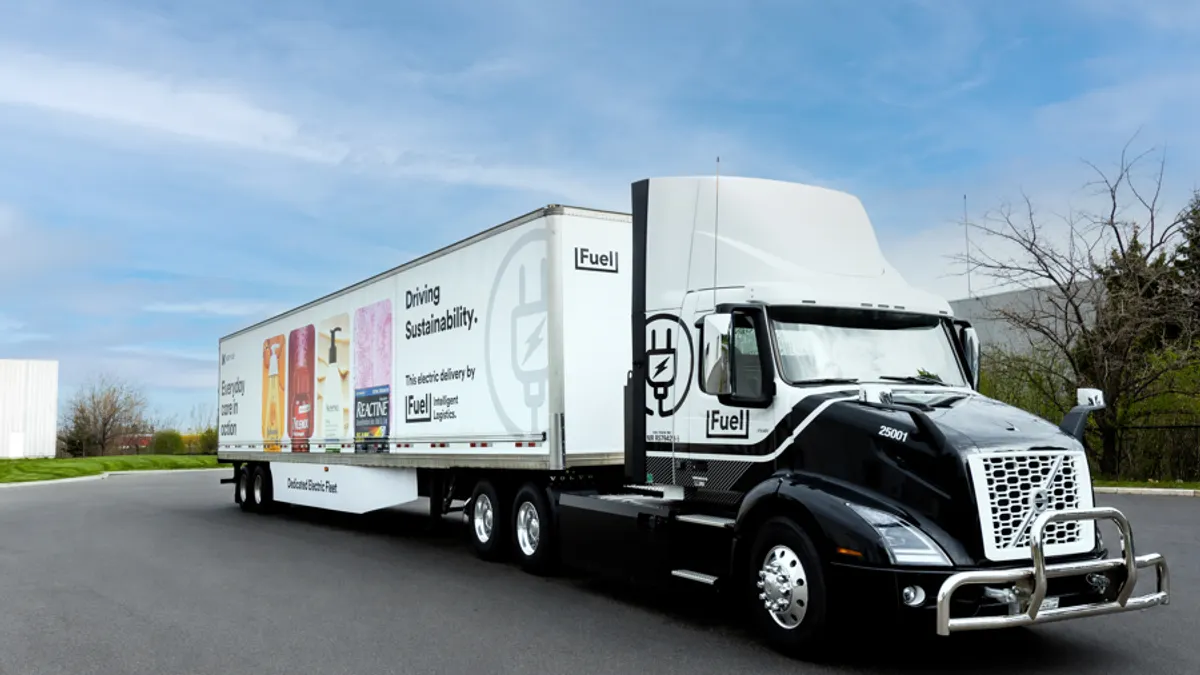
Fuel Transport’s short-haul electric vehicle pilot with consumer products giant Kenvue Canada yielded savings on diesel of nearly 45%, a company executive told Trucking Dive.
The logistics transportation company in January deployed an electric truck for a short-haul, multi-stop route in the greater Toronto area for Kenvue, maker of personal care products including Aveeno, Listerine and Neutrogena. Now more than five months since the launch, Fuel VP of Operations Peter Perrella, said in an email the evaluation has gone well and could expand into other markets including the U.S.
“We’re always open to working with partners that are exploring more sustainable transportation models and looking at how those solutions can function operationally inside real supply chains,” Perrella said. However, right now the focus is to learn as much as possible about how the EV truck performs in an urban environment.
While recent volatility in diesel prices has companies exploring ways to reduce fuel costs, Perrella noted its pilot with Kenvue is less about benchmarking short-term cost savings and more about understanding long-term viability of EV trucks. Use of an EV truck on the Toronto test route resulted in a 44.7% savings on diesel, Perrella said.
“Fuel prices are only one piece of the equation,” he said. “We’re evaluating the broader operational realities around charging integration, route planning, utilization, infrastructure requirements, maintenance considerations, and overall service reliability.”
Because the pilot is still active within a live network, Fuel is focused on gathering more operational data over time, Perrella said. The pilot will run through December.
Toronto offered the right test setting
Electric truck deployment and installation of heavy duty charging ports has progressed across the U.S. and Canada.
A study released in December by FPInnovations in collaboration with Transport Canada examined a 12-month deployment of Class 8 battery electric trucks in the greater Montreal area. Key findings of the study found:
- Over a six-year period four battery Class 8 trucks, each traveling 90,000 kilometers annually, would have a cost advantage of $856,486 compared to diesel trucks.
- The trucks consumed 60% less energy and produced at least 80% less greenhouse gas emissions
- The vehicles performed well under load and were preferred by drivers in many ways
However, the report also noted downsides to the Class 8 EV trucks. Some vehicles only operated between 150 and 200 kilometers per day, less than half the advertised range but that was due to limited charging infrastructure. The vehicles also encountered longer maintenance times compared to diesel vehicles.
The report highlighted that both drivers and dispatchers likely needed more training and better knowledge on the operation and capabilities of electric trucks, which “could lead to further efficiency gains, such as awareness of vehicle range and strategies to optimize mileage accumulation.”
These are similar factors that weighed into Fuel’s decision to conduct a pilot with Kenvue.
Perrella said both Fuel and Kenvue have invested into the pilot. Fuel invested in the vehicle, charging infrastructure and broader operational testing, while Kenvue’s contributions came on the operational side, he said.
Costs for installing charging infrastructure will vary based on various factors including location, charging level and type of charger used, according to the Department of Energy’s Alterternative Fuels Data Center. Estimates in a 2023 report from the North American Council for Freight Efficiency note a Level 2 AC charge could cost “several hundred to a few thousand dollars per charger,” while DC fast charger or Level 3 charger may see installation costs of between $15,000 and $90,000 per unit.
When including not just fuel but also infrastructure costs, a regional return-to-base route might cost 42 cents per mile for BEV, compared to 35 cents per mile for diesel currently, NACFE said in a 2026 report.
Because Kenvue and Fuel had operational familiarity, it aided when implementing the pilot to adjust the supply chain network, from scheduling and routing to charging integration and delivery planning, Perrella said.
Chris Mascella, senior director, head of supply chain Canada for Kenvue, said in the release that collaborating with Fuel allowed the company to advance a more resilient and sustainable supply chain network.
“This pilot reflects the practical steps we’re taking to reduce emissions while continuing to reliably deliver the everyday care Canadians rely on,” he said.
Perrella said working with Kenvue on a route in the greater Toronto area provided an opportunity to test how an electric truck would perform in dense delivery routes, congestion, and multi-stop delivery windows.
“Running the pilot in Canada also allowed us to evaluate performance across colder weather conditions, which is an important part of understanding what scalable electrification could realistically look like in North American freight operations,” he said.
What Fuel learns from its pilot program in metro Toronto will help in planning future EV deployments in other markets where it operates.
“Over time, those learnings can help inform broader deployment strategies across different markets and operating environments, including potential opportunities in the U.S. where the route structure and operational model make sense,” Perrella said.